How about some old gear

  • Thread starter Thread starter rob aylestone
  • Start date Start date
rob aylestone

rob aylestone

Moderator
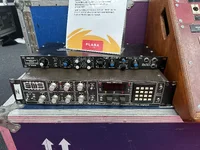
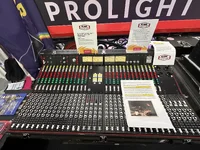
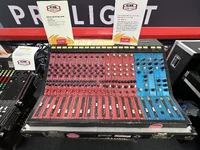
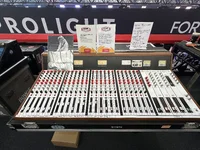
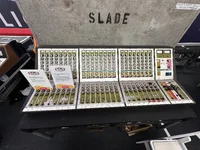
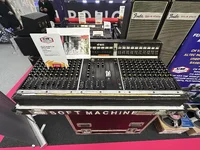
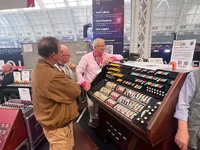
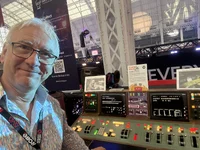
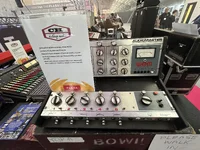
I’m at the PLASA show in london and in the classic gear we have some live sound mixers from the eras of David Bowie, the Stones, pink Floyd, slade and others. Chris who is collection it now has the complete pink Floyd Pompeii rig. He’s loaned it to Nick Mason for some of his charity events he supports here in the U.K. The band Slade might not be that well known to those in the US, but they were huge here in the Glam Rock days. Really great to see the old stuff. Oddly I was next door with old lighting gear, including the original lighting console for Jesus Christ Superstar from 1976 to 1980 in London’s West End. If anybody is interested, I can post a few pics of that. We were also demonstrating the original Genesis vari lites and controls. Explaining to younger folk that in Jesus Christ Superstar, the cast were using handheld mics and a few chain worn lava, with cables, and the choreography ensured the cables didn’t get tangled, but if they did, the XLRs had the locks removed so they would pull out. This show also had some of the first radio mics used here, including one on the big cross Jesus was on that hid the huge battery!
 

Attachments
  • IMG_3808.webp
    IMG_3808.webp
    1.2 MB · Views: 154
  • IMG_3809.webp
    IMG_3809.webp
    1.6 MB · Views: 67
  • IMG_3807.webp
    IMG_3807.webp
    1.4 MB · Views: 60
  • IMG_3802.webp
    IMG_3802.webp
    1.1 MB · Views: 70
  • IMG_3803.webp
    IMG_3803.webp
    1.1 MB · Views: 60
  • IMG_3804.webp
    IMG_3804.webp
    1.3 MB · Views: 70
  • IMG_3805.webp
    IMG_3805.webp
    1.6 MB · Views: 62
  • IMG_3806.webp
    IMG_3806.webp
    1.3 MB · Views: 66
Last edited:
Amazing…love this. Thanks for posting. So cool. I thought Slade was great, BTW.

Would love to see the lighting stuff.

Thanks for sharing all the great pics and anecdotes. Pure gold.
 
Ugh those consoles are sick, sick, sick. Wow.
 
The Slade mixer was found in a barn, with ivy growing up the front, across the top and down the back! The anecdote from the Pink Floyd/Nick Mason event was that it blocked all the main roads for miles around, and raised a fair bit of money for charity.
 
I'd like to see what was used for lighting Jesus Christ Superstar.
 
The control that looks like a church organ was the one used on Jesus Christ Superstar from 1976 to 1980, when it closed. It was put in the Palace Theatre, Shaftesbury Avenue, London, in 1956! The other control is a Lightboard. Memories, screens, keyboards. It went into the National Theatre in 1976. So BOTH were in use at the same time. Both have the Strand branding, but one is built into a Compton organ console, and uses the organ registration memory to control groups of lights. 120 channels and 14 memory groups. This works out to a modern memory of 1.6Kb! All done with solenoids, relays and real crosspoint wires.
 

Attachments

  • IMG_0118.webp
    IMG_0118.webp
    138 KB · Views: 40
  • IMG_3797.webp
    IMG_3797.webp
    1.7 MB · Views: 33
Oh! ***k! Rob, I was at the PLASA show a year ago but could not get there this. Not that interesting for me but I did get a Sound Devices pen! Loved to have seen that old kit and meet you.

Dave.
 
Our visitors ranged from a really keen 16 year old that has already helped with one ancient control to people even older than me. It's a huge draw - so much so that some of the big names are grumbling.
 
Our visitors ranged from a really keen 16 year old that has already helped with one ancient control to people even older than me. It's a huge draw - so much so that some of the big names are grumbling.
My son in law took me down in his FTL AMG Merc last time. If I get enough of a heads up next year he might repeat the exercise! He booked a parking space online in a side street about 10 mins walk from the venue.

Dave.
 
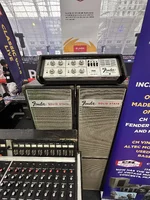
I remember the days when this was a workable PA system. 4 channels, hi-Z dynamic mics, and reverb. No XLRs, or phantom power.

1789256484464.webp


A setup like this covered a lot of gigs for around 1969-73. We had 4 x 8" speakers per side, 100 watts. I think it cost us $800. I imagine it sounded dreadful compare to a lot of basic systems today. We rarely heard it directly... there were no stage monitors!

1789257064160.webp


​

 
I remember the days when this was a workable PA system. 4 channels, hi-Z dynamic mics, and reverb. No XLRs, or phantom power.

View attachment 153315

A setup like this covered a lot of gigs for around 1969-73. We had 4 x 8" speakers per side, 100 watts. I think it cost us $800. I imagine it sounded dreadful compare to a lot of basic systems today. We rarely heard it directly... there were no stage monitors!

View attachment 153316


Well! At least they were on the right lines with the column speakers. These give a much better radiation pattern than single 12s in plastic boxes and thus help to reduce acoustic feedback, the bane of the PA man's life.
Of course, this only works if the speaker is used vertically. I cannot tell you how many idiots ran them on their sides thus making feedback even worse
 
Of course, this only works if the speaker is used vertically. I cannot tell you how many idiots ran them on their sides thus making feedback even worse
you cannot run it sideways?

Why is this?

I think everybody had their dream gear, when it all happened. For me it would be something else. LIke a DX-7 and Korg M3R are perfect dream machines. In the 80's it is what we used. You lived it. It WAS special. Or not. I dont know anymore..
 
you cannot run it sideways?

Why is this?

I think everybody had their dream gear, when it all happened. For me it would be something else. LIke a DX-7 and Korg M3R are perfect dream machines. In the 80's it is what we used. You lived it. It WAS special. Or not. I dont know anymore..
Acoustics 101 Beak. When a sound source is bigger than a wavelength it becomes directional. Thus such a column radiates in an omnidirectional pattern in one plane but is restricted in the other. That other is the horizontal plane WHEN the column is vertical. The benefits are that less sound is directed to ceiling and floor (and thus wasted and reflected) and more goes directly to punters. Such speakers also have a greater "throw" since they don't quite follow the inverse square rule. Another benefit is an SPL "gain" as the sound not going every effing where is concentrated towards the audience.
This effect falls apart as the column length approaches a wavelength so you need 'king long columns to get down to 50Hz say. You see these flown at festivals.

Incidentally, this "size gain" effect is what makes 4x12 and especially stacked 4x12 guitar speakers so bloody loud!

Dave.
 
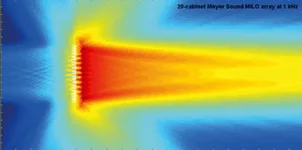
I've always thought it quite funny that many people read Line Array and think of concert flown systems, but in the 50s - the dreadful acoustics for speech in Churches and things like outdoor events got column speakers into vogue. Often band limited with small drivers - that has come around again hasn't it. We had open back and closed back versions and that squashing the vertical response while leaving the horizontal polar field very wide was just what was wanted. Last year at the London show, the classic folk recreated the rooftop concert the Beatles gave on the roof of the Apple building. Same drums, guitar amps, guitars and the same column loudspeaker and amps. It got complaints from exhibitors on the lower floor because it was too loud. a couple of hundred Watts. Back to the column - when you stack speakers closely together you get a unified sound front. Their output in that plane couples and gets louder. As the 'cone' from each speaker overlaps, a more intense area is created and this then overlaps with the next ones and so on. The direction of the overlapped field is straight in front. above the top one it spreads in the same way it spreads sideways. You create a very loud lobe mainly in one direction but with very little height. Turning them horizontal works against you. to get width you turn up the gain, and it become feedback hell. It worked so well in churches it then created what we now call time alignment issues - the people on one side near their thin speaker on the church roof columns was nearly the same volume as the column on the far side, so they heard multiple arrivals. In the 50's that was just tough. in a few years with electronics we invented delays for large spaces - and all the problems that solution then produced! Just history repeating itself.
 
Acoustics 101 Beak. When a sound source is bigger than a wavelength it becomes directional. Thus such a column radiates in an omnidirectional pattern in one plane but is restricted in the other. That other is the horizontal plane WHEN the column is vertical. The benefits are that less sound is directed to ceiling and floor (and thus wasted and reflected) and more goes directly to punters. Such speakers also have a greater "throw" since they don't quite follow the inverse square rule. Another benefit is an SPL "gain" as the sound not going every effing where is concentrated towards the audience.
This effect falls apart as the column length approaches a wavelength so you need 'king long columns to get down to 50Hz say. You see these flown at festivals.
I disagree on the practical part. You can place the speaker cabinet sideways if that's your thing. Direction is important. Height. Where it is pointed. The guitars relation positionally to it is important.
Incidentally, this "size gain" effect is what makes 4x12 and especially stacked 4x12 guitar speakers so bloody loud!

Dave.
Dave, I disagree. You sound over-educated. Power rating of the amplifier makes it loud. Matching the speaker wattage to amplifier wattage makes it loud. Lowering the speaker ohm makes it louder in comparison. Feeding the power amp a +4 signal that's meant for a -10+ signal, makes it seem louder than it is. Common for them only turn up to 2 or 3 on the dial.
 
I disagree on the practical part. You can place the speaker cabinet sideways if that's your thing. Direction is important. Height. Where it is pointed. The guitars relation positionally to it is important.

Dave, I disagree. You sound over-educated. Power rating of the amplifier makes it loud. Matching the speaker wattage to amplifier wattage makes it loud. Lowering the speaker ohm makes it louder in comparison. Feeding the power amp a +4 signal that's meant for a -10+ signal, makes it seem louder than it is. Common for them only turn up to 2 or 3 on the dial.
And you sir are under educated. Stop talking acoustic bllx.
 
I'm right.

If the cabinet is upright on the stand or sideways on the stand, makes no difference.

Make a video with sound demonstrating this reflection, upright and turn the cabinet on it's side. Play just a clear single A note. 10-20 seconds long.
 
The 30W that comes out of an AC30 is earshattering. My 300W Behringer bass amp into an 8 x 10" cab is way quieter.
This pic is what happens when you align multiple speakers - hardly anything goes up or down, the rest goes forward. If you rotate the speaker to horizontal the left to right is really narrow. This is really, really old physics - and every single line array manufacturer uses it in their designs. Just how physics works. No need for a video - it's easily findable and widely understood physics.
 

Attachments

  • Screenshot 2026-09-15 at 14.15.50.webp
    Screenshot 2026-09-15 at 14.15.50.webp
    28.5 KB · Views: 23
Back
Top