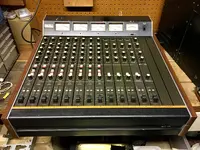
Hello, sorry to revive this thread again. I recently acquired a TEAC Model 5B as well. I took it to a repair shop; the technician told me it's unrepairable: 4 channels are dead and the other 4 have issues. However, he didn't give me any details on what is broken, so I'm kinda unsure of the verdict. Looking to get some detailed answers from him this Saturday. I was wondering if the Model 5 5A service manual can be used to service the Model 5B. Are the components between 5A and 5B similar? I do read that the op amp of the Model 5A uses the RC4558 IC and the 5B uses the RC4559 IC, but I don't find anything else regarding other components. I also recently found another broken Model 5B; the power supply is missing, but the channel's PCB is intact with its components, so it's possible I can salvage it to repair my current one.So I was going through old threads of mine updating links to pics and vids and such...I thought I had linked a video tour of the Model 5B I captured sometime ago in this thread, but I don't see it...so here it is for future generations...
YouTube
BTW, I love your video on your TEAC Model 5B; it's very rare to see an in-depth walkthrough of the insides of this mixer. Thank you!!Hello, sorry to revive this thread again. I recently acquired a TEAC Model 5B as well. I took it to a repair shop; the technician told me it's unrepairable: 4 channels are dead and the other 4 have issues. However, he didn't give me any details on what is broken, so I'm kinda unsure of the verdict. Looking to get some detailed answers from him this Saturday. I was wondering if the Model 5 5A service manual can be used to service the Model 5B. Are the components between 5A and 5B similar? I also recently found another broken Model 5B; the power supply is missing, but the channel's PCB is intact with its components, so it's possible I can salvage it to repair my current one.
What do you have in terms of test equipment Greg? As the bare minimum IMHO you will need a moving coil scale millivoltmeter and a sine wave generator which covers 10Hz to 50kHz minimum. Such kit used to be readily available online from Da Bay and elsewhere. Probably not as common now? "Levell" was an excellent brand of both units.Hello, sorry to revive this thread again. I recently acquired a TEAC Model 5B as well. I took it to a repair shop; the technician told me it's unrepairable: 4 channels are dead and the other 4 have issues. However, he didn't give me any details on what is broken, so I'm kinda unsure of the verdict. Looking to get some detailed answers from him this Saturday. I was wondering if the Model 5 5A service manual can be used to service the Model 5B. Are the components between 5A and 5B similar? I do read that the op amp of the Model 5A uses the RC4558 IC and the 5B uses the RC4559 IC, but I don't find anything else regarding other components. I also recently found another broken Model 5B; the power supply is missing, but the channel's PCB is intact with its components, so it's possible I can salvage it to repair my current one.
I'm sorry, but I'm kinda new to this, and I don't know much regarding electronics and audio equipment testing. Forgive me for my lack of knowledge. I'm mainly a Game Sound Designer for a livingWhat do you have in terms of test equipment Greg? As the bare minimum IMHO you will need a moving coil scale millivoltmeter and a sine wave generator which covers 10Hz to 50kHz minimum. Such kit used to be readily available online from Da Bay and elsewhere. Probably not as common now? "Levell" was an excellent brand of both units.
Alternatively you could use a good audio interface and Right Mark Analizer, free software which can also test for harmonic distortion, that latter is useful in deciding if you need to re-cap.
A decent digital multimeter WILL work but beware. Most are not accurate past about 2kHz (yes!TWO!) and you will need to make a very low noise pre amp for reliable results below about 10mV. If you can find an old AVO 8 or Simpson meter you can build the mV front end on one. Also look up Wireless World audio test projects.
Dave.
Yes, I'm also questioning the verdict, will see this Saturday. Hopefully its just the "there is no identical spare part left" reason, I do have a donor coming in, so thst wouldn't be a problem. And thank you for the pointers and the reassurance, and about the manual for the testing part, I will try to get the relevant tools.An analog mixer like the Model 5 Series…it boggles me how it could be deemed as irreparable…probably rude of me but I’m questioning the skill of the tech you contacted. With the exception of the the pots, mic transformers and VU meters, EVERYTHING on a Model 5 is standard through-hole components, and it is very easy to work on with its modular design…good gracious…IMO I’d work on an analog mixer any day over a tape machine…my hunch is the tech doesn’t have the patience to take the console through all the basic stuff you have to do with something of that type and age so they are just chalking it up to “can’t be fixed”. That’s my hunch. And if I’m right that is super-lame. For the 4 channels that aren’t working, step 1 basically check that power is getting to them. And in general the switches are terrible by this point. Every switch becomes a point at which signal may stop or be highly compromised. I would get some DeoxIT D100 and apply it to every switch and exercise throughly and then apply more. The contacts are brass and they oxidize. At the extremes you can replace the switches. IIRC it’s a pretty standard footprint. The backplane cardedge connectors for the modules probably also need to be exercised. Now, if a rodent got into the cavity between the module backplane and the jack panel and chewed up wires that could be not fun to repair, but it’s not at all impossible. So I guess I need more info about what’s happening to so more, but D100 on the switches and cardedge connectors, and F5 on the pots and faders. 9 times out of 10 those measures of applying appropriate treatment to the pots and switches and exercising things will bring it around so you can know what else that’s more complicated is going on. But straight up dead channels, if they are getting power, that can just be one dirty oxidized switch and you can usually get those working.
I’m not for sure the difference between the 5 and 5A…maybe that was the upgrade from the 4558 to the 4559. And then if that’s the case I think the only difference between the 5A and 5B is colored knob caps vs all putty colored. The service manual for the 5/5A applies to the 5B. You can use it interchangeably. No differences in functionality or circuit design that I know of. Somebody correct me if I’m wrong please.
Test equipment: in your situation I would, if you have a smartphone, get a tone generator app for your device and use that for test tones. You don’t need a low distortion oscillator or anything like that. And then look for a digital multimeter (DMM) that is “true RMS” measuring and is rated for audio bandwidth. Your garden variety multimeters are only accurate for AC volts up to maybe 400Hz or maybe 1000Hz if you’re lucky. But the audio band standard is 20Hz to 20kHz, so you want a meter that is rated to be relatively accurate across that frequency range. So as long as you have that, and can measure DC volts and resistance, and can make some tones, that’s kind of the basic level of tech equipment and not hard to get. You don’t really need an oscilloscope for what you need to maintain with an analog console like that. There are no distortion null trimmers or phase adjustments or anything like that. It’s pretty basic.

Greg, to paraphrase Mr Vader, "your lack of experience disturbs me" I would suggest that you buy in a few basic audio kits. Vellemann make a good range. A small power amp, 7 watts or so (linear NOT class D) would be a good start and can be used as a signal tracer. I feel sure there is a basic audio signal generator in the range as well? I hope you have a good solder "station" not just a gash solder iron. A station will be temperature controlled and work for lead free solder. It will also come with various 'bits' for fine and chunky work. Here you can get decent one for £50.Yes, I'm also questioning the verdict, will see this Saturday. Hopefully its just the "there is no identical spare part left" reason, I do have a donor coming in, so thst wouldn't be a problem. And thank you for the pointers and the reassurance, and about the manual for the testing part, I will try to get the relevant tools.
Yea, to be honest in my country there a little who can do proper maintenance and restoration on vintage gear, and almost none who are willing to touch an analog mixer such as these.
Also do you by any chance has ever encountered a TEAC Model 1? I got lucky and found one alongside the dead donor for the Model 5B. I see little to no mention for this summing mixer. Mine probably have some power supply issue, the seller told me it can't be turned on and the pics he sent me of the inside are still good at least imo, willing to try bringing it to service, hopefully lady luck is still on my side
kit-amp.com