Tascam M-30 mixer - problem with submix panning

  • Thread starter Thread starter golf_richards
  • Start date Start date
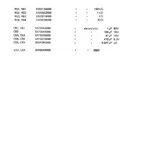
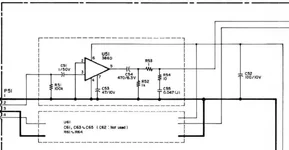
Schematic of headphone amp.
 

Attachments

  • 1788992129997.webp
    1788992129997.webp
    28.1 KB · Views: 13
  • Headphone Amp Components.webp
    Headphone Amp Components.webp
    23.8 KB · Views: 10
  • Headphone amp schematic.webp
    Headphone amp schematic.webp
    22.6 KB · Views: 10
Schematic of headphone amp.
Ha! Doesn't give a value for R53 (and it's too tiny for MY eye!) but the R is followed by a pretty low Z "Zobel" network so I am guessing 33 Ohms or so? That should protect the chip. Thanks chap.

Dave.
 
Ha! Doesn't give a value for R53 (and it's too tiny for MY eye!) but the R is followed by a pretty low Z "Zobel" network so I am guessing 33 Ohms or so? That should protect the chip. Thanks chap.

Dave.
I have updated my previous post.
 
I shall try to find the relavent circuit but it is unlikely that the headphone circuit would be damaged by the use of a TS plug though of course you would only get the left channel. This is because historically, headphone amps had a physical resistor of between 22 and 80 Ohms in each output circuit. The resistors performed several useful functions. They tended to equalize the power into headphones of various impednace. They kept the amps stable even on very long lines and, most importantly, they protected the ampliiers from shorts.

About a decade ago there started a fashion for headphone amplifiers have a very low, often nominally zero, output resistance. I am not sure how "bombproof" such circuits are, especially at the budget end of the market?

Dave.
Unlikely? No. The manual cautions the reader a TS plug in the headphone jack “…will cause circuit failure…”
 
M-30 headphone circuit below…the block on the left…period typical using a pair of 386D single opamps:

IMG_0702.webp
 
M-30 headphone circuit below…the block on the left…period typical using a pair of 386D single opamps:

View attachment 153303
Ah! I can now see why my friend! R53 seems to be just one Ohm? The LM386 has a minimum load resistance of 4R*and so had mssrs Tascam made R53 just 4R7 the circuit would have been totally short proof and there be no need of a warning! As I said, almost all headphone amps used a series R for decades and 4R7 would not affect level nor sound quality. Were that mixer mine I would whip out R53 pronto and replace it with 22R or thereabouts.

*Even so, I am betting the 386 would simply current limit, it's a power amplifier after all and 't'appen (especially in a STOODIO where there are zillions of TS cables about and almost as many idiots!) I also see that they run the amp from less than 10V and that will further protect it.

Dave.
 
The LM386 is not output current limited. I think the supply is +6V unipolar for the headphone amp. Yeah odd a low value output resistor was not spec’ed. Not sure why. I’ll have to look in some other period devices because Teac used the LM386 in a number of headphone amps. I’m not a fan, really. It’s noisy and requires a power supply distinct from the rest of the signal path. I will say the M-30 manual hints further up from the headphone amp warning on page 33, relative to other circuits that require care in selection of the connector type, that it’s not an instant zorch…”…just because it seems to function when you try it for a moment or two, don’t assume that we are overly cautious and keep on. Sooner or later it WILL blow (2 to 3 minutes)…” which reads like a thermal-stress failure to me…maybe.
 
"The LM386 is not output current limited." Is it not? That's why they don't say so in the TI data sheet then! Bit of a design boo-boo for a power amp can I suggest? But ancient Tascam are not alone. I read a review of a high end device a couple of years ago which made great play of its "zero resistance" headphone amps but then gave the same warning! Not good design for professional kit IMHO.

386 noisy? There is better now. I cannot think of the type number but Behringer use them in their excellent HA400 HP amp and the same chip is used in some much classier gear.

Dave.
 
386 noisy? There is better now. I cannot think of the type number but Behringer use them in their excellent HA400 HP amp and the same chip is used in some much classier gear.

Dave.
4560. Which is still a pretty great chip for when high output drive is needed. That’s it’s super-power and there aren’t a lot of options that can perform to its level for high drive. The datasheet doesn’t speak to the output current, but the preamble notes it is capable of driving 20V pk-pk into a 400R load which is pretty beefy for an IC opamp. And the bandwidth, slew and distortion specs are not bad considering its drive capability.

I’d be happy to swap 4560s in for 386s, but that’s another thing I don’t like about the 386 is its odd pinout…between that and the fact it is a single opamp AND the typical dedicated lower voltage supply rail make it a project to incorporate something like a 4560.
 
Back
Top