
New owner of Neotek Series III. You guys weren't exaggerating about the level of commitment.

  • Thread starter Thread starter AnalogApples
  • Start date Start date
A

AnalogApples

Member
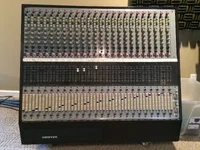
I thought I'd update you guys on a recent development at my private studio. I just got back to Madison WI from Nashville with a 24 channel Neotek Series III console that's been converted into a side car. He basically sold it to me for a song. It's totally wired up to a punchblock and patchbay, with cables coming from the punchblock that go to all my gear. My first observation, this thing is enormous. Everything is double the size of my Tascam M3500. Looking at it is messing with my mind because photos make it look like a modern, compact console, but in person it's huge. One fader panel barely fits in my hand. The knobs are huge, the pots feel totally different, like I imagine big gears underneath turning as I rotate the knob. So strange! The appearance just screams "REAL professional console'

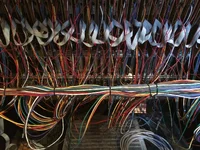
My second observation is that the wiring is humbling. It must've taken a team of technicians an entire week to run wires from the channels to the punchblock-to the patchbay. Hundreds of pounds of copper bundled in rubber so thick it looks like fire hoses coming from the console. I can see how the cables cost $thousands to purchase, and additional thousands to connect.

Also, patch bays are a new frontier of mystery for me. Normalled, half normalled? Good grief. I have many questions, and since large format consoles are not as common as my Tascam, educational material is limited.

Right now it's set up so that you use 2 of the 24 busses as a master 2 mix. There are no master channel cards. The only card that isn't an input module is a reverb return module, which i'm guessing outputs it's signal to the patchbay--but how that ends up back into my 2-mix--i'm going cross-eyed.

Right now I'll be using it to preamp and EQ my mics before my tape machine, a Tascam MS16. It's a +4 console, so I think I can use the XLR ins/outs of the tape machine. There's a switch in the tape machine that changes the operating volume so I have to check if that needs to be switched. Then I'll run the tape machine back through the console to mix, out to busses, and into my Tascam M3500 so I still have master channels and VUs of my 2-mix signal.

Long term, I'm on the hunt to buy all the channels that would make it a factory complete Series III. I THINK I just have to wire the master channels into the patch bay, and I'll be good to go. I'll be adding on to its wooden frame to create a spot for the meter bridge, and for all the remaining master channels. The console wiring appears simple enough. I'm really hoping the master channel PCBs have labeled solder points for wires.

I am so excited to get this into factory shape so I can sell or donate my Tascam M3500 32 channel. There's too many huge consoles in my house right now.

Has anyone tried restoring the master sections of a sidecar console? Was it a wiring nightmare, or pretty straightforward Inputs and outputs, power etc?

Interesting: He says he paid $10,000 for the console, and another $7,000 to wire it up back in the late 80s. I paid him 12% of that amount, so you do the math. Like I said, a song.
2nd photo is the rear of the console, so you can see it looks deceptively simply wired. I'm hoping the master cards have similar simple wire ins/outs.
 

Attachments

  • 01 Neotek Front Full.webp
    01 Neotek Front Full.webp
    713 KB · Views: 77
  • Open.webp
    Open.webp
    798.4 KB · Views: 63
It looks like all that wiring on the rear is 'wire-wrap'. You'll need tools.
It does look old.
 
It looks like all that wiring on the rear is 'wire-wrap'. You'll need tools.
It does look old.
He gave me all the wiring tools in the sale, fortunately. And yeah, it's almost as old as me! I haven't powered it on yet so the suspense is intense.
 
I thought I'd update you guys on a recent development at my private studio. I just got back to Madison WI from Nashville with a 24 channel Neotek Series III console that's been converted into a side car. He basically sold it to me for a song. It's totally wired up to a punchblock and patchbay, with cables coming from the punchblock that go to all my gear. My first observation, this thing is enormous. Everything is double the size of my Tascam M3500. Looking at it is messing with my mind because photos make it look like a modern, compact console, but in person it's huge. One fader panel barely fits in my hand. The knobs are huge, the pots feel totally different, like I imagine big gears underneath turning as I rotate the knob. So strange! The appearance just screams "REAL professional console'

My second observation is that the wiring is humbling. It must've taken a team of technicians an entire week to run wires from the channels to the punchblock-to the patchbay. Hundreds of pounds of copper bundled in rubber so thick it looks like fire hoses coming from the console. I can see how the cables cost $thousands to purchase, and additional thousands to connect.

Also, patch bays are a new frontier of mystery for me. Normalled, half normalled? Good grief. I have many questions, and since large format consoles are not as common as my Tascam, educational material is limited.

Right now it's set up so that you use 2 of the 24 busses as a master 2 mix. There are no master channel cards. The only card that isn't an input module is a reverb return module, which i'm guessing outputs it's signal to the patchbay--but how that ends up back into my 2-mix--i'm going cross-eyed.

Right now I'll be using it to preamp and EQ my mics before my tape machine, a Tascam MS16. It's a +4 console, so I think I can use the XLR ins/outs of the tape machine. There's a switch in the tape machine that changes the operating volume so I have to check if that needs to be switched. Then I'll run the tape machine back through the console to mix, out to busses, and into my Tascam M3500 so I still have master channels and VUs of my 2-mix signal.

Long term, I'm on the hunt to buy all the channels that would make it a factory complete Series III. I THINK I just have to wire the master channels into the patch bay, and I'll be good to go. I'll be adding on to its wooden frame to create a spot for the meter bridge, and for all the remaining master channels. The console wiring appears simple enough. I'm really hoping the master channel PCBs have labeled solder points for wires.

I am so excited to get this into factory shape so I can sell or donate my Tascam M3500 32 channel. There's too many huge consoles in my house right now.

Has anyone tried restoring the master sections of a sidecar console? Was it a wiring nightmare, or pretty straightforward Inputs and outputs, power etc?

Interesting: He says he paid $10,000 for the console, and another $7,000 to wire it up back in the late 80s. I paid him 12% of that amount, so you do the math. Like I said, a song.
2nd photo is the rear of the console, so you can see it looks deceptively simply wired. I'm hoping the master cards have similar simple wire ins/outs.
I’m happy that people like take on jobs like this - for 2000 bucks it is still a lot of work - and where do you put it?
 
What a project. Yikes. I must be getting old…I’m not sure I’d take that on myself. But great find.

Did you get any documentation with it? I only have a nine-page “brochure” which has a lot functional detail in it. The EQ is pretty great function-wise with the switchable Q on the mid bands, switchable peaking/shelving on hi band and the lo band I’m not sure if it’s natively peaking or shelving but it is switchable to a swept HPF. The EQ performance is supposed to be pretty spectacular.

Congratulations!
 
That’s a LOT of switches and pots to clean!

Lots and lots of wire too!!!

I’m happy that people like take on jobs like this - for 2000 bucks it is still a lot of work - and where do you put it?
Since it's not stock, the patchbay is separate. That makes it about the same dimensions as my Tascam M3500. Once I tack on some more frame for the additional channels, I'll put it right where the Tascam is. I'm renting a 2 bedroom house with a huge open kitchen living room area. like 33' by 18'. So the master bedroom is the mixing-listening room and the living room is the live room. The drum set is in my kitchen behind the counters, since that's about halfway in the room. I'm shocked at how much better the bass drum sounds in the microphones in a large room. I even tried putting a breakfast nook bench in front of the kit, which blocked the bass drum halfway up--totally changed the sound of the drum. I've heard bass notes have like a 20 foot long wave form and small rooms don't support bass well. I really lucked out with my old 1915 house. Plus the foundation is settling badly, so none of the walls or floors are perfectly parallel anymore--bonus! haha

Fortunately I'll be able to use it for recording and mixing while I'm slowly restoring it. I'm not a trained technician, I just had to learn the basics in order to fix all the old stuff I buy, so I'll be taking my time with this.
 
Last edited:
What a project. Yikes. I must be getting old…I’m not sure I’d take that on myself. But great find.

Did you get any documentation with it? I only have a nine-page “brochure” which has a lot functional detail in it. The EQ is pretty great function-wise with the switchable Q on the mid bands, switchable peaking/shelving on hi band and the lo band I’m not sure if it’s natively peaking or shelving but it is switchable to a swept HPF. The EQ performance is supposed to be pretty spectacular.

Congratulations!
Thanks for the congrats! Yeah, I wasn't expecting the EQs to have push-pull pot switches. There's a push pull on all 4 EQ bands, I thought that was only on the Elan's and Elites--maybe I was thinking of the adjustable Q on the Elites. I have a binder with all the schematics for every Series III PCB, and the manual. The manual is surprisingly limited. Seems more like an overview of the features and it says nothing about a typical signal flow or how to use the patch bay. I have no information about how the patchbay was wired, just labels above the jacks. I guess depending on how it was soldered, it's either normal or half normaled.

Since the manual is basically "our mixer has these features" and nothing about how to use it, explaining the board must've been the technician's job when the board was commissioned. It's going to be a fun evening plugging a test tone into the patchbay to see where it goes!
 
Since it's not stock, the patchbay is separate. That makes it about the same dimensions as my Tascam M3500. Once I tack on some more frame for the additional channels, I'll put it right where the Tascam is. I'm renting a 2 bedroom house with a huge open kitchen living room area. like 33' by 18'. So the master bedroom is the mixing-listening room and the living room is the live room. The drum set is in my kitchen behind the counters, since that's about halfway in the room. I'm shocked at how much better the bass drum sounds in the microphones in a large room. I even tried putting a breakfast nook bench in front of the kit, which blocked the bass drum halfway up--totally changed the sound of the drum. I've heard bass notes have like a 20 foot long wave form and small rooms don't support bass well. I really lucked out with my old 1915 house. Plus the foundation is settling badly, so none of the walls or floors are perfectly parallel anymore--bonus! haha

Fortunately I'll be able to use it for recording and mixing while I'm slowly restoring it. I'm not a trained technician, I just had to learn the basics in order to fix all the old stuff I buy, so I'll be taking my time with this.
That is totally a true thing regarding the drums. The environment is grossly interactive with the kit. I love the sound of a well tuned kit in a small auditorium, not just because of natural reverb, the drums sound and even *feel* big. They feel different because they resonate differently. Small rooms or confined spaces or features frustrate the kit. The only exception to this for me is my Whisper Room. I got a small Whisper Room years ago for a really good deal, and because of the material it’s made from and the fact it is completely lined with carpet, the reflections in the space are vastly controlled, which leaves more of the true tone of the drum…controlled sound, and this also works great for mic’ing. That’s the other really hard part about small spaces is the reflections and what mics pick up. So the Whisper Room is not good for any ambiance whatsoever, but it’s great for applying post-production effects to the drum tracks because of the lack of reflections or room noise…so for me it’s either a nice big room or the tiny closet of a space in the Whisper Room. They both work for different reasons.

And hey I have no formal electronics or tech training, just decades of asking a lot of questions, taking some risks, making a lot of mistakes, asking more questions, reading, reading, reading, and working on a lot of stuff and not being afraid to dive into new things, and it’s gotten me to a point where I’m pretty capable within a narrow band of the electronics world. Some education would have been good. It’s been a long road so far, but overall enjoyable.
 
Thanks for the congrats! Yeah, I wasn't expecting the EQs to have push-pull pot switches. There's a push pull on all 4 EQ bands, I thought that was only on the Elan's and Elites--maybe I was thinking of the adjustable Q on the Elites. I have a binder with all the schematics for every Series III PCB, and the manual. The manual is surprisingly limited. Seems more like an overview of the features and it says nothing about a typical signal flow or how to use the patch bay. I have no information about how the patchbay was wired, just labels above the jacks. I guess depending on how it was soldered, it's either normal or half normaled.

Since the manual is basically "our mixer has these features" and nothing about how to use it, explaining the board must've been the technician's job when the board was commissioned. It's going to be a fun evening plugging a test tone into the patchbay to see where it goes!
The Neotek consoles were built for and with the professional studio in mind, not the home-based or “project” studio. So the assumption is there are professional engineering and/or technical staff onsite and many times the manuals seem lacking, but that’s because the people operating and maintaining the console only really cared about a block diagram maybe a spec sheet and schematics, parts lists, wiring diagrams and board layouts, mainly.

Truly all one really *needs* in order operate a console is the block diagram and maybe the spec sheet if there are questions about impedances, nominal levels, etc. to interface other equipment. Information in a typical operations manual though is nice to have and helpful for sure, but one can get by on those bare minimums above.
 
Last edited:
The good thing about old stuff is you can trace all the wires and tracks, get datasheets on components, and map out a circuit diagram yourself.
 
Case in point about why a service manual seems mandatory. Power supply voltages are incorrect by .5% to 10%. +48 is 48.3, -24 is -26.5, -18 is -19.1, and +18 is +16.9. Measurements were taken with it unloaded.

7 trim pots inside, none are labeled. And it’s a custom power supply.

Look at the huge size of those capacitors though! 🤩
720C9E33-606B-4692-A476-B88E09493457.webp
 
Last edited:
Case in point about why a service manual seems mandatory. Power supply voltages are incorrect by .5% to 10%. +48 is 48.3, -24 is -26.5, -18 is -19.1, and +18 is +16.9. Measurements were taken with it unloaded.

7 trim pots inside, none are labeled. And it’s a custom power supply.

Look at the huge size of those capacitors though! 🤩View attachment 151302
Great news! Only 4 pots were labeled VLT ADJUST so I figured out which pots were for which outputs and adjusted them all to the correct numbers! Woohoo! Now I can plug it into my console and smell for smoke heh
 
You’ll need to recheck while loaded. You might end up adjusting those trimmers about back to where they were. +/- 5-10% in this case is not a big deal.
 
On that right hand pcb there looks like a 14 pin DIL chip in a cheap and nasty socket. Always a worry. I'd at least check that it is seated well.
Then there's those interesting parallelled up resistors.
 
Years ago, I got a DDA D Series console for basically free. It probably weighed at least 500lbs. I got most of the wiring, but it was on Ramlatch connectors. I took it apart, cleaned it, recapped a bunch of the channels and power supply, solved some issues, and had it for a year or two before I decided it just wasn't worth it for me.

The DDA was too big and it wasn't designed to work with a DAW, so there were a lot of issues to solve, but it was kind of cumbersome to work with.

I bought The Box by API and never looked back. Sure, it was more money (and the cabling was super expensive - all custom-made Mogami). It's really each to move it around, it doesn't take a lot of power, and it's still newer. I love it.

Here is my DDA:
490513308_10235485684831682_5929095500825987947_n.jpg


Downsized! Exact same space!

597437133_10239118881339324_836697734672216237_n.jpg
 
If you price what you get when you buy The Box, it's a great deal, plus your impedance matches so well through everything. It has a few quirks to keep it from competing with the 1608 too much (i.e. no returns for the sends) but these can be worked around because of how flexible the routing is. I know Scott has one as well.
 
I looked at 'The Box' and also some Trident desks, but chose to steer clear because we may not get too good support
in the UK. For me, it was a toss-up between a Neve 8424 and an SSL XL Desk. Being local counts for a lot.
 
I looked at 'The Box' and also some Trident desks, but chose to steer clear because we may not get too good support
in the UK. For me, it was a toss-up between a Neve 8424 and an SSL XL Desk. Being local counts for a lot.
That's why I didn't go Neve. I've never cared for the SSL sound, but they make great stuff.
 
Back
Top