How to record an upright piano using 3 microphones?

  • Thread starter Thread starter gkalsdl2004
  • Start date Start date
G

gkalsdl2004

New member
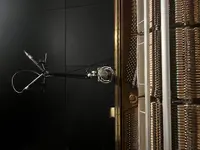
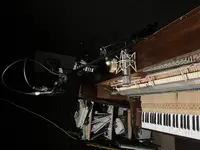
Hi I am recording a piano using two small-diaphragm condenser microphones and one large-diaphragm condenser microphone.

The small-diaphragm pair is positioned in an XY configuration. I tried using an ORTF setup, but the positioning between the piano and the microphones didn‘t seem quite right.

I’d appreciate any feedback on whether my current microphone placement has any issues or if you have any alternative placement recommendations.

I could use separate stands for each microphone, but due to the amount of other equipment, I have to place all the microphones on a single stand. Thanks😊
 

Attachments

  • IMG_4280.webp
    IMG_4280.webp
    2.1 MB · Views: 485
  • IMG_4281.webp
    IMG_4281.webp
    1.6 MB · Views: 436
Hi I am recording a piano using two small-diaphragm condenser microphones and one large-diaphragm condenser microphone.

The small-diaphragm pair is positioned in an XY configuration. I tried using an ORTF setup, but the positioning between the piano and the microphones didn‘t seem quite right.

I’d appreciate any feedback on whether my current microphone placement has any issues or if you have any alternative placement recommendations.

I could use separate stands for each microphone, but due to the amount of other equipment, I have to place all the microphones on a single stand. Thanks😊
Can you post at recording? It looks fine - but I can’t tell how it will sound.
 
Yeah - let's hear it. I've never done it before of course. But my first thought was: why three mics instead of two?
 
Yeah - let's hear it. I've never done it before of course. But my first thought was: why three mics instead of two?
I saw some videos where people record an upright piano using four condenser microphones봳wo near the hammers and two on the back or lower panel. But my favorite musician, Kiefer, mentioned that he enjoys recording piano in mono.

So I thought, what if I use a large-diaphragm microphone for mono along with two SDC. Could this be a problem?😭

I don't think there's a big problem from what I hear, but I was hoping to get some advice if there are better options. Maybe I can post the recording on Monday 😊 thanks👍
 
I saw some videos where people record an upright piano using four condenser microphones봳wo near the hammers and two on the back or lower panel. But my favorite musician, Kiefer, mentioned that he enjoys recording piano in mono.

So I thought, what if I use a large-diaphragm microphone for mono along with two SDC. Could this be a problem?😭

I don't think there's a big problem from what I hear, but I was hoping to get some advice if there are better options. Maybe I can post the recording on Monday 😊 thanks👍
Please be aware.... I don't know my *ss from a hole in the ground. Seriously - I'm a big time novice. And I've never recorded a piano. I was just thinking that beyond two mics - you may be complicating things unnecessarily. But I don't have any experience to draw from whatsoever.😉
 
Last edited:
The thing here is that the clever techniques, like the ORTF and variants of X/Y are designed to record larger groups of performers and they do a decent job of capturing a stereo field that reproduces properly on replay, with depth and placement info.

On both grands and upright pianos, the sound really comes from the soundboard so there's never really a proper left and right, so crossed pairs from 70 through to 120 degrees produce different results. Close in, what you tend to get is the basic tone of the piano with not that much left and right difference on the basic sound, but you do get the dampers bashing the strings when they mute in sort of enhanced 'stereo' - can sounds really good, but it's not really ORTF of the others, because they're not designed to do this job.
If you have time, I'd strongly suggest connecting one of the mics to some closed back or in-ear headphones and turn the level up and try all sorts of positions. Some will be thin and weedy, some darker and maybe a bit dull on the bass strings. Two mics, in the best positions for capturing the entire range of strings and harmonics work, when panned modestly, not mega wide which for effect is great, but not for realism. Uprights suffer because the gubbins that connect keys to hammers is in the way. Far less so on grands. The most common recording positions seem to be two space small diaphragm condenser, one pointing down to the left and the other doing the same job on the higher strings - the sound board sounds tend to emerge that way, as well as the string tones.

The pics of your placement suggest that you'll get a bit of a weak tone from the pair, and more meaty sound from the centre mic. Depending on the piano, this could be brilliant, or absolutely awful. You can generalise on rough techniques, but some respond very differently. Yamaha C3s could have one mic under the sound board, pointing upwards just behind the pedal board frame. (unless it creaks). The same position on a G2 sounds horrible. I recorded a piano a few years back with different positions, including the mic held in my hand moving around. Might be worth a watch.

I actually did a more recent video with just a single mic -that's quite good with a bit of reverb to be fair.
 
There's about a million ways to record a piano. The obvious thing that looks wonky about your setup is that the LDC is at a great distance to have phase issues with the SDCs.

If I were to do 3 mic recording... My first impulses would be SDCs at opposite ends of the piano, and LDC across the room. Or reverse that: LDC in the middle of the piano, and SDCs in a stereo pair across the room.
 
Steve - that's rarely is three mics a problem on pianos, because the entire instrument is a time arrival nightmare, BUT, this gives it the characteristic sound. low strings can be nearly 6ft from the highest ones, so with two or more mics, it's always going to have timing issues leading to the phasing. The bass strings are always in the mic pointing at the treble ones, because the soundboard carries them right across. Your comment on the SDCs across the room, with the other close in is pretty much what the sample package people tend to do - but only in a good room - in my piano room here, room mics sound terrible and boxy. On a stage or in a proper space, it can be gorgeous.
 
I've had some decent results placing the mics on the back, 2 PZMs on the wall about a meter off the floor and about 60 cm apart, with the piano about 30 cm out from the wall.
 
All this talk about ORTF, and I realized I didn't have a convenient way to setup a pair of mics - so I found a pattern on thre Lewitt website and made one out of some thin plywood. The 6.2" opposing capsule locations are important so this jig gets you there pretty quickly. The JPG should be accurate at 100% off your printer. Feel free to make your own!

PS: I should have an opportunity to record a gifted 12-year-old on a baby grand so need to be ready...
ORTF Mic Pattern.webp
ORTF Mic Setup.webp
 
I thought we’d covered this. ORTF is a fine technique but importantly, it needs space to work properly, so the baby grand will need to be in a big room or you will be recording what bounces off the walls! My grand and my room work against ORTF. Sounds boxy. I doubt any ORTF engineers ever had a jig. 5” or 7” makes no difference I can hear, as does tweaking the angles. In real world recording the killer is the ORTF hole in the middle and the limit to left and right spread so while it works well, it must be in the right place. In some spaces the thing you are recording might be better matched to X/Y. In a big, lovely sounding space my starting point for ORTF would be in the curve about 4 feet away at about head height. Dont forget that the object is to record the piano in almost mono with the space providing the stereo information because pianos are weird instruments with the sound coming from everywhere. 5 and 6ft grands have very little width, audio wise.
 
Now, I have not tried recording an upright or grand piano but it seems to me that the first question one should ask oneself is "why"? More to the point, like acoustic guitar, where in the mix do you want the piano to appear?

An X/Y setup close in will result in a huge acoustic image going speaker to speaker. Might be what you want but it is more usual to "sit" an instrument in the centre if it is the main solo part.
On stage the piano will be side on to the audience and so have very little width. As ever with home recording it depends upon whether you are trying to create "a reality" or an effect?

Dave.
 
Sounds like nobody knows how to record a piano with any assurance of success - doubters abound!
I'll look to mic manufacturers like DPA for some input on practical steps to approach this subject.
 
Sounds like nobody knows how to record a piano with any assurance of success - doubters abound!
I'll look to mic manufacturers like DPA for some input on practical steps to approach this subject.
A bit presumptuous to say that nobody knows how to record a piano. Maybe you didn't really understand what was being said.

Here... maybe this will help. Take your pick of 13 different ways to do it.

 
Nobody knows? To be honest, I've been recording them for ever. Maybe you are just annoyed we are not swooning with the reception you got when you added to this old topic. I mean, maybe some of us might (well, we actually weren't) be insulted by your revelation of ORTF. Clearly you have read a lot about it, but not quite understood the 'why' or the problems it has.

I have enough gear to do a pretty decent job in most rooms on most pianos. I'm just more likely to pick different techniques to suit the space. I can manage classical, jazz and pop pretty adequately - enough to get paid,

We ARE doubters - your success will be based on if the piano is receptive to your ORTF pair and the room sounds really nice. Most rooms pianos are in do not! If youdo some experiments with ORFT, you will find you don't need a template - you just use a T-Bar and adjust to suit. In fact, you will also discover that if you use a single mic, and route it to headphones and move it around while somebody plays, the tone changes very little with big movements of the mic. This is why ORFT is a big room technique. If you use it close, the science behind the accurate stereo capture with pressure and time differences works against you.
 
No need to get all upset, gentlemen. I was simply prodding for some more details on this subject. Generalities aren't of much use so excuse me for looking to get constructive answers or direction. I realize this is not YT with tuorials, hence my need to look elsewhere for something in depth.

"you will also discover that if you use a single mic, and route it to headphones and move it around while somebody plays, the tone changes very little with big movements of the mic. "
Actually, 'rob' offered at least one tidbit here (I had already thought of) and that's what I was after. Apologies to any 'doubters' my response may have caused.
PS: I'm taking your uninvited jab at my jig as water off a duck's back, so try not to be too sensitive yourselves...
 
So did you even listen to the different methods that were in the video? You're the one who will be in the room and will know what the room is like and what sound you want. Do you have your heart set on using ORTF or are other methods possible candidates?
 
The jab at the jig, isn’t a dig at the product, or your implementation of it, it’s just the idea that quoting an angle with half a degree in it is pointless, and a level of accuracy that sort of points to the non-practical recording community. It is IMPOSSIBLE to offer anything other than generalities, because you have been unwilling to share any practical information to even allow us to provide what you want. As an example, make, model and operational mode of the piano. As in lid off, full stick or half stick or shut. The most appropriate placement for a Yamaha is not the same as a Steinway, and a Yamaha C3 is different from a G2. Indeed, as a supportive anecdote, I was trying to record a Yamaha concert grand supplied by Yamaha for a prestigious stage event, and they wanted it played lid on full stick by a German Schubert pianist, who had hands like a karate master. The only good sounding mic placement was unacceptable because of the optics. They did look ugly, and it had to be beautiful. The pianist took me to one side and told me to trust him, as he had played this piano hundreds of times. He asked if I had an AKG C414. I had. He put the cable over the centre strut underneath, and dangled it down. Then he turned it back to pointing upwards, and taped the mic to the cable. He handed me the XLR. He said add just a little bit of the biggest reverb you have and record that, they will be very happy. My face showed my deep concern and he laughed. I was probably 30. He was my age now. He told me this worked on only this piano, and it sounded amazing and really real, and had no mechanical noises. I’ve tried it dozens of times since and most times it was awful, and just a few times passable. None good. Yamaha Europe were very happy. The video people just added my recording. No EQ. I still have the reverb unit Yamaha gave me. Their very first digital sampled reverb. It is stuck on the Munich cathedral preset, because the remote was lost years ago.
 
Back
Top