Dampening . . .

  • Thread starter Thread starter chessrock
  • Start date Start date
C

chessrock

Banned
Was wondering if anyone out there has any thoughts / ideas on dampening a mic that has some serious resonant freq's going on.

To anyone who knows about this kind of thing: How difficult is it? And do you know of anyone who does work on mics who might be able to do something reasonably ($100 or less) ?

While I'm at it, are there any "mic moders" out there? I know Stephen Sank is good, but he only works on ribbons from what I gather. Any guys out there who do some of the Tapeop, Royer or Dorsey type mods? I suppose there could be a market for that sort of a thing. I'm not much of a DIY'er in case you couldn't tell. :D

So yea, I guess I'm entertaining offers. So if this is something you do, go ahead and pimp away.
 
Fill it with wax. It can make an electric guitar behave. Try it and tell me if it works or if it fucks up a mic.
 
Track Rat said:
Try it and tell me if it works or if it fucks up a mic.


Alright, Track Rat . . . I'm going to go fill up all of my mics with wax and report back to you on my findings.

What a great idea! :D

Like that's ever gonna' happen.

This kinda' reminds me of the time I had some serious cotton mouth going on, and one of my roommates in college told me to try a big mouth full of peanut butter. :D "yea, dude. That's a sure-fire cure for cotton mouth."
 
chessrock said:
Was wondering if anyone out there has any thoughts / ideas on dampening a mic that has some serious resonant freq's going on.

To anyone who knows about this kind of thing: How difficult is it? And do you know of anyone who does work on mics who might be able to do something reasonably ($100 or less) ?
First. you hafta figure out exactly what is resonating and where it's resonating. You can tap on various parts of the mic while it's on and see if you can hear it bonk. Stick-on felt strips or silicone putty can help usually damp the resonance (or eliminate it to a large degree).

Unfortunately, it's a matter of trial and error, and that kind of repair usually winds up costing a lot of money. DIY fixes can work well, since it really involves mostly time while you track down the problem.

The usual suspects are the grill assembly, the body, or the capsule suspension. If you remove the tube surrounding the mic body and the resonance stops, then the problem is the body and you apply the felt strips there, wherever you can without interfering with the electronics.

If it's a grill resonance, felt strips (or silicone goop) behind the inside grill supports can sometimes stop it.

Capsule suspension problems are a lot more difficult. Adding mass can often help by lowering the frequency of the suspension to where it no longer resonates.

Mostly, it's just a matter of time and patience.

I also want to add that resonances are not always indicative of poor design; sometimes the tolerances of the various components just happen to add up in the exact combination to create a problem.
 
Last edited:
Hey, thanks for the quick and most helpful response, Harvey.


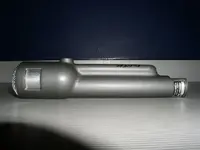
I'm sure there are folks familiar with this mic. As ugly as it is, I've been having sort of a fixation with it's sound lately -- I like the focused midrangy thing it does to a voice. But man, does it ever have some dampening issues that could be addressed! :D Whooo - weee!

If you look at it's design, I'm sure it's pretty obvious where the issues would be. The thick metal body just has this metalic ring to it. It's still a very cool mic, but I think it would be a lot more useful in a lot more situations if that ring wasn't quite so obvious.


Thanks again!
 

Attachments

  • evpic.webp
    evpic.webp
    14.6 KB · Views: 494
An old EV with "Variable D"? That could be a problem, since EV put in a ton of internal chambers to eliminate a lot of proximity effect when used up close. Change the size of the internal chambers and you can really mess up the sound. If you don't care about the appearence, add some silicone globs to the body, since they can be removed if they don't help.

The other thing to try is to call somebody at EV and get friendly with one of the techs or designers. Sometimes, they'll take on a project simply from a curiosity standpoint, or as a challenge.
 
I've done a fair amount of mic modding of Oktavas and various Chinese mics and reported the results on rec.audio.pro (search my name and "mods" on Google groups) and at Tech Talk over on recording.org

re: dampening - I've tried various applications of silicon RTV, a lead foil-backed roofing tar type product, rubber "O" rings, felt plus hose clamps and adhesive-backed foam weather stripping.

On the Oktava MK-219 (one of the "boinkiest" mics ever made) I settled on the foam weather stripping - placed several strips on each half of the inside of the mic case. When closed, the case compresses the foam and dampens the body resonance quite well.

The Oktava ML-52-02 ribbon was more of a problem. I practically wrote a novel over at rec.audio.pro about my efforts to stop it from ringing. Long story made short...I ended up replacing the stock grille with a hand-rolled wire screen.

The Oktava MK-319 resonance problem is not as bad as the 219 but not perfect. I settled on two approaches - 1.) a new wire grille made in an Ela-M 251 style with just the smallest strips of solder holding it all together and 2.) converting the 319 into a bottle-style mic with the capsule mounted in a round "lollipop" grille assembly.

The whole issue of grille size and shape has interested me for a while. I pulled together a number of quotes from microphone experts on head grille effects and posted it to rec.audio.pro:
http://groups.google.com/groups?q=g...0312171348.13282bb0@posting.google.com&rnum=1

Lets see...other mods lying around here...

Using an MXL V63 and an Oktava MC-012 I built a large diaphragm / small diaphram tube mic system. I replaced the stock head amp in the MC-012 with Dave Royer's subminiature 5840 tube (pentode-wired-as-triode) Cathode follower circuit. I took the 10dB pad, removed the attenuation cap from it, and mounted it to the bottom of the MXL V63 capsule/grille assembly. So now either the large diaphragm V63 or the small diaphragm 012 can screw onto the 5840 tube amp.

Yeah, a tip of the hat to Grizz Royer, made a couple of LDC tube mics out of MXLs, "bottom feader mic shoot out" over at rec.audio.pro describes the results:
http://groups.google.com/groups?q=b...0304050622.2a67420d@posting.google.com&rnum=1

The Oktavas are so cheap its fun to turn them into Omnis too - pull 'em apart, rip off the back diaphram and fill the acoustical labyrinth with 5 minute epoxy. Really great room mic and I also like it for close mic vocals without proximity effect.

Oh, I always pull the mechanical HF boost disc off the 219/319 capsules - cuts HF 4dB @ 10kHz but improves transient response. The result is a slightly darker mic (which is dark to begin with) but one that has great clarity (if the grille mods are also done).

Inside a LDC head grille...usually put some little conical-shaped foam inserts around the base of the capsule mounting post tapering up to the bottom of the capsule. Helps to absorb and deflect spurious reflections created from HF bouncing around between the head grille surfaces and the flat plane of the capsule mounting surface.

Then there's signal path capacitor mods...swapping a Lundahl transformer for the stock ML52 unit...putting an MK219 capsule in a lollipop on top of MXL "Shoeps / Dorsey" FET head amp...pulling all the fine wire mesh out of all my mics head grilles leaving just one layer of course screening...

Actually Chess...I've been thinking about starting an "Oktava chop shop" specializing in the type of MK319 mods I've described above. Don't know if there's a market for them though.

But, this MK319 Bottle I built is pretty unique looking and awesome sounding.

best to all, MJ

 
Chess,

The damping resonances is probably one of the most tedious and time consuming work on the mics. With your EV you could probably try to fill the external cavity (between bigger and smaller body tubes) with silicon, then enclose the outside into shrinkable tube (probably even two layers) and cut the windows for backwave paths. If it doesn't work right, you can always take it off.
The easiest way to improve the performance of the mic would be--put a foam ring on the bottom of the capsule around mount suggle, and take off a second layer mesh of the grill along with silk thing, leaving only thicker, external mesh--this one should provide enough shielding. However, there are two restrictions here--no outdoor use, unless you use foam windscreen, and pop filter is a must.

<The Oktavas are so cheap its fun to turn them into Omnis too - pull 'em apart, rip off the back diaphram and fill the acoustical labyrinth with 5 minute epoxy. Really great room mic and I also like it for close mic vocals without proximity effect.>

Michael,
I was thinking about it when I got my Oktavas, but then droppped the idea. Here the main problem, as I see it--the cardioid capsule is a pressure gradient type and is resistance controlled. The tuning resonance is in the middle of the band, and then, the peak is damped with acoustical resistance. The omni is a pressure type, and is stiffness controlled. That's why the diaphragm should be tuned into high frequencies. Very small back chamber increases the frequency tuning, however, for optimum, the diaphragm itself should be tensioned to higher frequencies as well. Otherwise you get a compromize on HF response.

re: ML52. I don't know if you saw my resent post on TT about this mic...
Although I did not play with this mic and don't know the foil specs, but knowing general tendency of Oktava's QC I'd suspect that its double ribbons are not tuned the same, and foil doesn't have an optimal mass. I would think the proper tuning along with use of lighter foil will greatly improve performance.
Interesting, against of our intuition, because of nature of the force on ribbon, the lighter foil does not improve HF; but the resonances are damped much better than with the thicker ribbon. But ribbons are another big can of worms....
 
Last edited:
The biggest problem I see with DIY mic modifications is that often you're trading one set of problems for yet another set of problems. And how do you determine what results you've actually achieved?

Yes, it may sound better on your voice, or for your purposes, but it may not be a useful fix for every other mic of that model. Without the proper equipment to actuall measure what you've done, there's no way of knowing whether a mod is "better" or just "better for you".
 
Harvey, you're so right.

I'm glad you made the distinction between individualized DIY and universially replicable manufacturing. As you know so well, getting a design from experimental stages to profitable production involves many choices and trade-offs.

Lately I've been thinking of mic moding as being a bit like urban Honda or Toyota customization - a production model gradually is transformed into a unique expression of its owner and it assume greater and greater value, but for fewer people. Mass customization.

Marik - good point about the dual ribbons in the ML-52. No doubt differences in ribbon tuning acounted for differences I heard in four different mics at Guitar Center. I picked the one that sounded best on my voice.
 
<The biggest problem I see with DIY mic modifications is that often you're trading one set of problems for yet another set of problems. And how do you determine what results you've actually achieved?

Yes, it may sound better on your voice, or for your purposes, but it may not be a useful fix for every other mic of that model. Without the proper equipment to actuall measure what you've done, there's no way of knowing whether a mod is "better" or just "better for you".>

Excellent points, Harvey.
Everything depends on personal tastes. It reminds me 'audiophil' battle between "paper and oil caps and horn speakers" and "polypropilene caps and planar speakers". Obviously if you remove plastic resonator in 219 or 319 the sound will change. Another thing--will it work for everyone? I am for one who beleives that the system should be as transparent and have as much resolution as it is possible in order to reveal the qualities of the capsule. If I don't like the capsule, I try to retune it when it is possible. If it doesn't work, I just take another capsule. Not always measurement tells us about sound, but I beleive, if you take a chipo Chinese mic with crapy caps inside and change the circuit let's say with optimized tube one and use good parts, it is gonna be a better mic. If you damp the parasitic grill resonances and reduce standwaves and reflections inside of the grill, it is gonna be a better mic. Will it work for you? I dunno.
 
Harvey Gerst said:
The biggest problem I see with DIY mic modifications is that often you're trading one set of problems for yet another set of problems. And how do you determine what results you've actually achieved?

Yes, it may sound better on your voice, or for your purposes, but it may not be a useful fix for every other mic of that model. Without the proper equipment to actuall measure what you've done, there's no way of knowing whether a mod is "better" or just "better for you".
How true, its usually just a bag of trade offs. There's a few though, that I would heartedly recommend. The Dorsey/Schoeps mod to any 6 micron Chinese mic with the cheap transformer being one. Can't imagine anyone not preferring that over the original!
 
<its usually just a bag of trade offs.>

Yep, that's the reason why there is no such thing as "perfect mic", or "perfect speaker" in our imperfect world.
 
Yes, and Scott Dorsey's mod is easily measurable as to the improvement in performance of the electronic circuit. As to some of the other "improvements", let me illustrate with a personal story of my own, involving Mike Rivers's Beyer M260, which Stephan Sank modified for Mike, with astounding results:

Mike sent his 260 to me to see what I thought of the mod and I was really impressed; it sounded very similar to my beloved RCA 77DX. I was impressed enough to call Stephan Sank and he said he'd do the mod on my Beyer 260.

Since I decided to drive to the AES show in LA that year, my son and I stopped in Albuquerque and we watched as Stephan modified my Beyer 260. When he finished, the difference was amazing, but, I didn't think it sounded "exactly" the same as Mike's 260 (which I had brought with me to give back to Mike at the show).

The bodies of the 2 Beyer 260 mics were different shapes, but it was a top end difference I was hearing. He fiddled with retensioning the ribbon and got the low end the same, but there was still the difference in the high end which couldn't be accounted for.

Finally, we removed the gauze material fron inside the ball end and the top end suddenly cleared up. We replaced the thin (almost transparent) original Beyer black gauze with a single layer of the RCA silk and that did it. The original gauze in the Beyer didn't work with the new ribbon.

My point is that without a reasonable and accurate way to test any mods, you're never sure whether it's an" improvement", or just a "change" - maybe better, maybe worse. In my case, I had Mike Rivers' mic with me and a mint 77DX at Stephan's house to make my comparisons.

Even Stephan didn't catch it at first, and he's lived with ribbons all his life (his dad designed most of the RCA ribbon mics). But once you start mucking about inside the sound chamber of any mic, there's a risk that you can make one thing better while making something else worse, and that's all I'm trying to point out.
 
BTW Harvey,

I am not sure if you are still following ECM8000 mod thread. I wanted to ask if you would be willing to check this mic after it is done. I think many folks here would greatly appreciate your opinion about the moded mic. I could send it to you if you have some time to give it a try. If yes, please PM me with your address.
 
Harvey Gerst said:
...We replaced the thin (almost transparent) original Beyer black gauze with a single layer of the RCA silk and that did it.
Great story.

BTW, I need some of this "RCA silk". Any idea where I can get a foot or two?
 
Flatpicker said:
Great story.

BTW, I need some of this "RCA silk". Any idea where I can get a foot or two?

I see it frequently on ebay.
 
Flatpicker said:
Great story.

BTW, I need some of this "RCA silk". Any idea where I can get a foot or two?

I'm sure Clarence Kane at ENAK, Wes Dooley at AEA, and Stephan Sank all have a lot of it.
 
Marik said:
BTW Harvey,

I am not sure if you are still following ECM8000 mod thread. I wanted to ask if you would be willing to check this mic after it is done. I think many folks here would greatly appreciate your opinion about the moded mic. I could send it to you if you have some time to give it a try. If yes, please PM me with your address.
I'd be honored to hear your changes, and yes, I've been following the ECM8000 thread with a great deal of interest. My address is pretty common knowledge:

Harvey Gerst
8676 Travis Road
Sanger Texas 76266
(940) 482-3422
 
Back
Top