very small garage studio advice please

  • Thread starter Thread starter joolzsmith
  • Start date Start date
J

joolzsmith

New member
Hi. I want to create a small studio within an external garage located some 20m from the house, and same distance from any neighbours. The main use of the room is electronic/keyboard recording but with some live vocal/drums use. The garage construction is a pre-fabricated cast concrete construction with more acoustic holes than a wire-mesh sieve! i have read the relevant chapters in Rod's book but i dont feel it has answered my most important question.
The garage internal maximum width is just 2.76m and the usable length is only 4m. I have considered building the std. "room within a room" idea using the double drywall design as shown in rod's book which shows an stc of 63. The problem with this plan is that i will lose significant amounts of width within my 2.7m wide shell and will end up with usable space of less than 2m wide! I can set my drum kit in less than 1.8m width but wont have much leeway. So i'm wondering whether i would be better off replacing either 1 or both drywall leaves with medium density concrete block? i'm aware of the requirement for mass-air-mass but in this very small space do i stand any chance of creating enough isolation?

If i created a single concrete block outer shell with a stud wall and double layer drywall on resilient channel for the inner wall will this work? Or, can i save even more space by using just a single concrete block shell with double drywall on resilient channel fixed direct to the inside of the concrete block? If so, do I use any glassfibre wool or green glue between the drywall sheets?
This room doesn't have to be exceptionally isolated due to its distance from neighbouring properties but will this work? I guess many of you will say, it's all just too small.. but I don't have any other option. I can't extend the outer shell of this small UK garage, and have to work within these limits.

All advice would be welcome!
Many thanks, Joolz.
 
The garage construction is a pre-fabricated cast concrete construction with more acoustic holes than a wire-mesh sieve!
If i created a single concrete block outer shell

I don't get it. "pre fabricated" Cast concrete...as in WALLS? or Concrete block?:confused::confused:

I have considered building the std. "room within a room" idea using the double drywall design as shown in rod's book
If i created a single concrete block outer shell with a stud wall and double layer drywall on resilient channel for the inner wall will this work?

Hmmmm, Whats the difference? BTW, you don't need RC if your studs don't touch the concrete shell. Although, your ceiling may need it if the joists are suspended on the concrete shell walls. If you have a seperately framed cieling supported by your "stud walls"...you have a room within a room, although you still need to decouple your floor. And there are a few ways to do this. First off, you could seperate your slab from the exterior shell footings by pouring a seperate footing integral with the slab to support your interior shell. Or you could decouple your stud framing from a slab via resiliant isolators and build a floating floor BETWEEN the stud walls...OR...float a floor and build your stud framing on TOP of the floating floor...but no matter what....VOILA! Room within a room:confused:

However,you don't want to loose the space, but yet you are asking about a seperate inner leaf via stud walls.:confused: Hmmmmm. I think you are confused as well. There is no difference between a room within a room...and framing an interior leaf with studs. At least as far as taking up floor space is concerned.

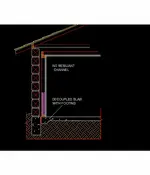
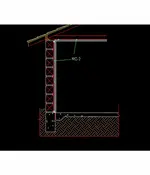
Perhaps you should consider filling the concrete block with sand as its being built(if thats what you end up using vs "pre-cast" concrete "walls) then sealing the interior face with plaster(or some other form of sealant), and then fastening FURRING strips to the concrete block, and THEN use RC on both walls AND cieling joists to decouple the drywall. The furring strips can be simple 1x2. This will save you a few inches around the perimeter. Not much for all the work it takes to align RC. But, sometimes, every inch counts. Just a thought.
fitZ
 
Last edited:
Here is what I mean. Not much saving in space.
fitZ:)
 

Attachments

  • WallSections1.webp
    WallSections1.webp
    20.3 KB · Views: 354
  • WallSections2.webp
    WallSections2.webp
    17.8 KB · Views: 335
Actually, I don't know how much Transmission loss you are actually trying to achieve, but under some circumstances, you may NOT even need to decouple the slab from the footing. It just depends on your goal.
fitZ:)
 
Or, can i save even more space by using just a single concrete block shell with double drywall on resilient channel fixed direct to the inside of the concrete block? If so, do I use any glassfibre wool or green glue between the drywall sheets?

Due to your space limitation this plan looks good. Use regular cheap pink insulation in the airspace between the drywall and the concrete wall.(Unless your are looking for thermal insulation as well) It should not be "packed" in. I would use Green Glue between the 2 panels of drywall. That will help a great deal.

If possible, you might want to look at clips and hat channel as opposed to RC. I believe you'd get a bit more airspace, and less chance for short circuiting. Doing the same on the ceiling should get you to where you want to be.

By the way... What kind of Drum Kit do you have?
 
Fitz.. thanks for your replies, suggestions and the great drawings too. Perhaps I didn't explain too well. The pre-cast prefabricated garage outer structure is already made of solid 2" thin cast concrete panels which slot and bolt together. They are like concrete slabs that form the outer skin of the building. As I said in the first post, there is essentially no sound insulation provided by this structure. Thus whatever I do inside of this skin will have to provide all the sound insulation I'm going to get - and within as small a space as possible.
So.. inside this outer shell my options for walls seem to be:

1. single concrete block
2. single concrete block/furring/RC/drywall/drywall
3. single concrete block/airgap/stud/drywall/drywall
4. drywall/drywall/stud/rockwool/airgap/rockwool/stud/drywall/drywall

Option 2 seems to provide reasonable compromise between an effective insulating structure in the minimum of space. I know I'm not going to get the best sound insulation with this- but is there anything more effective in the same width?
If I went for this option, what would be your thoughts on green glue between the 2 drywall layers?
Thanks again.
Joolz
 
So.. inside this outer shell my options for walls seem to be:

1. single concrete block
2. single concrete block/furring/RC/drywall/drywall
3. single concrete block/airgap/stud/drywall/drywall
4. drywall/drywall/stud/rockwool/airgap/rockwool/stud/drywall/drywall

Option 2 seems to provide reasonable compromise between an effective insulating structure in the minimum of space. I know I'm not going to get the best sound insulation with this- but is there anything more effective in the same width?
If I went for this option, what would be your thoughts on green glue between the 2 drywall layers?
Thanks again.
Joolz

You may want to consider your option 3 instead. Use insulation, and damping between the 2 layers of drywall.

single concrete block/airgap with insulation/stud/drywall/damping/drywall

Don't forget the ceilings. Sound will always find the weakest link.
 
You may want to consider your option 3 instead. Use insulation, and damping between the 2 layers of drywall.
:eek:

I hate to disagree with you John, but in the first place, I don't know how you would place insulation between layers of drywall, without creating a SECOND airgap which in the second place is a NO NO because it would create a THREE LEAF assembly, which is worse than a TWO leaf. Look at this.


partitions2c_663_146.gif


Look at the one at the far right. In Joolz case, this would be an exterior leaf(block or what ever) and the interior leaf(either furred out drywall or a stud assembly. Whats important is to create only ONE airgap. Period

fitZ:)
 
I'm very familiar with the undesired results of a triple leaf effect. (Cool to see someone else knows about it:)) Perhaps my post did not read clearly. I had suggested to consider his Option 3 with the addition of insulation, and damping in that assembly.(Joolz did not have those components in his Option 3) And in the the next line I described the assembly as he had with the addition of those. Perhaps it's better understood like this:

single concrete block
airgap with insulation
stud
drywall/damping/drywall

The insulation is to be put in the airgap, not between the boards. The damping goes between the boards

I also was thinking about the concrete block wall. Rick, what are your thoughts on weather or not it could create a triple leaf as well? The blocks, as I understand it, are hollow with an airgap an therefor would be 2 leaves with a little airspace, and when the new wall is built, that would be the 3rd leaf. 2 airgaps, and 3 leaves. I believe filling the concrete block somehow as Joolz had mentioned may eliminate this potential problem.
 
Guys. Thanks for comments so far. I'm rather pleased to see my query has sparked some debate which is always good in my book! There may be still some confusion. John, the existing concrete block wall of the garage cannot be filled to provide any degree of sound insulation.. there are too many gaps to make this possible.. and this is why whatever i build within this space has to carry the can when it comes to sound insulation.
I have wondered myself about whether the existing concrete block wall becomes the third leaf or not.. What is it about this exterior wall layer that makes it (or not) the third leaf? Is it something to do with the size of the air gap between this and the next leaf?
 
Howdy guys. As far as filling the block...well, no, it acts as one leaf I believe, due to the stiffness of the blocks. Unless you have the opportunity to fill them as you build the wall, don't worry about it. Two layers of drywall with green glue between should suffice. However, ALL your weak links need to be addressed. IF you need even more TL than two layers drywall and a non filled block exterior leaf, maybe consider Resiliant Clips hatchannel. Much more expensive though. OR, consider a stud wall and THREE layers of drywall and Resiliant Isolators and hatchannel for the ceiling with three layers. Maybe a floating concrete pad as well. If that don't do it, .........play softer.:D

http://www.johnlsayers.com/phpBB2/viewtopic.php?t=10169&highlight=concrete+block+fill
fitZ:)
 
consider a stud wall and THREE layers of drywall and Resiliant Isolators and hatchannel for the ceiling with three layers. Maybe a floating concrete pad as well. If that don't do it, .........play softer.:D

This sounds like the way to go. If using 3 layers of drywall, divide the damping into 2 layers. I know that GG's instructions say to use 2 tubes per 4x8 so you would use 1 tube for each damping layer.

Drywall > 1 Tube GG > Drywall > 1 Tube GG > Drywall.

The added mass and 2 damping layers really make a nice performing wall.

John
 
Hi Guys.. OK thanks again for latest advice.. now - finally let me get this clear.. do you mean the concrete block wall and then three layers of drywall with GG on a stud partition?.. or just the stud wall and three layers of drywall with GG? Cheers. Jules
 
Hi Guys.. OK thanks again for latest advice.. now - finally let me get this clear.. do you mean the concrete block wall and then three layers of drywall with GG on a stud partition?.. or just the stud wall and three layers of drywall with GG? Cheers. Jules

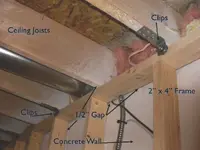
HI Joolz. I was under the impression that you were going to use the concrete block wall because the original wall is just a concrete skin. Correct? If so the more air space that you can get away with between this block wall and your drywall the better. If possible frame your wall so that it is decoupled from the block wall. Build a 2x4 wall 24 OC with the bottom plate at least 1/2"(or more) out from that block wall. Fill the air space with insulation. Then hang your drywall with GG. You will want to connect the top plate of these walls with clips to the joists.

I've attacked a picture to help illustrate. I hope this helped

John
 

Attachments

  • Clip S Stud Concrete Wall.webp
    Clip S Stud Concrete Wall.webp
    41.1 KB · Views: 242
John. Great help, thanks very much to you and Fitz for the various advice. I think I know how to progress from here. What I also know is that I'm not going to be able to save any width and I'll just have to accept that I'll be lucky to end up with anything more than 2m wide inside dimension.
Still, even this will be better than the "nothing" I've got now.. I'll just have to look forward to my next garage studio project..and then I'll have to make sure it's a double!
All the best
Joolz
 
Hey Joolz,

Good luck with your project. Please keep us posted on how it goes.

John
 
John. Believe it or not but I dont own this house yet.. but I'll be taking possession in July so the project will start soon afterwards. I'm really excited about it, but at least i've got the time to plan carefully. I'll get back on here if any more questions come to mind in the meantime. And I'll definitely return to give you some progress... when there is some!
Cheers
Joolz
 
Check out Auralex and their soundblock sheeting. I used it in by basement applying it over the studs and floor joists above then between 2 layers of 1/2 " wallboard decoupled from the walls and ceiling by a triple layer of "sill seal" foam (available at any home supply outlet) applied to the joists and studs first. Labor intensive. and you'll need some help-the soundblock sheeting is quite heavy. Hope this may be of some help.
 
Oh yeah, fiberglass makes a terrible soundproofing material. You need dense material. The idea is to stop sound transmission. All that fiberglass and acoustic-style foam will do is reduce reflected sound within the room, which you will need to do to some extent when you're finally into your space. Good Luck with your project.
 
John. Believe it or not but I dont own this house yet..

:eek:Excuse me? :confused::confused::confused: Get in touch when you own one. Orherwise, you are spiting in the wind. :mad: i.e. you can put all your dreams in a packet to the Federal Reserve, but untill some asshole that works for them says its ok for you to move into a property that you will NEVER own but they can't throw you out untill you don't make the payment, its all academic.
edit:
but I'll be taking possession in July so the project will start soon afterwards.
I just saw this, so maybe I spoke to soon and maybe not. All I know is ANYTHING can happen. On the day my escrow was supposed to close(which so happened to be the day before our loan procurement period ended), the local mortgage company office(Countrywide)closed their doors leaving 200 people without a loan and NO ONE was notified. It just so happened our broker saw it on the news. She got us another loan in ONE day:eek: Have you already got a loan? Considering the "sub prime" debacle, getting a mortgage now can be a real nightmare. Unless you can buy a home outright, which few people can do.
fitZ
 
Last edited:
Back
Top