
rew waterfall - how does this look?

  • Thread starter Thread starter CharlotLouie
  • Start date Start date
C

CharlotLouie

New member
Hi everyone

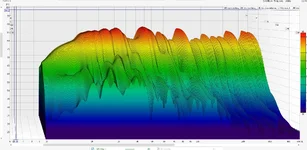
Does this waterfall look ok?
wf.webp

Even after watching several vids, like this one:


I am having an issue understanding how to properly read what I see. I guess, because mine doesn't look like what I see in the vids.

Thank you.
 
It looks to me like there's some resonance between 20 and 150 Hz, but it's at a fairly low amplitude.
 
The thing to remember is that all they do is show the amount of energy at each frequency. However, you haven’t explained what signal you put into the system, how you generated it, and how you got it back in?

I’m assuming you played some pink noise into a space, through loudspeakers, then stuck a mic out and recorded the room sound? This is the resultant trace. Or did you generate the noise into your daw, and what we are seeing in the trace from the audio generated totally inside the box? That would hopefully generate a totally flat line on a 2 D display, and a hump with flat top on a 3D display. In a real room, what you would see is an amalgam of the speaker response, the microphone response and the room components. It wont be flat. If you use a measurement mic, that has a very flat, omni response, then you are pretty much seeing the room and the speakers. If you took the measurement mic outside with the speakers, the. You’d see just the speakers, and probably a few birds!

On its own the trace tells us very little without context.
 
Looking at that colourful top picture, it is in 3D.
Left to right is frequency, bottom to top is volume, and from rear to the front is time.
I would guess they generate a spike (=all frequencies), and measure the frequency response over time.
Those foothills at the front/left will be the lower frequencies reverberating in the room.
The measuring mic can only be in one place though.
If they are going to publish that picture, they ought to explain just what it means.
 
Thank you for the responses.

This was generated with a 10hz to 20k sine wave sweep. There was one mic in the center of the room, routed to a focusrite audio interface, and then routed into rew.

So, how does this info help me figure out if I need to do anything in the room, and if so, what?
 
If we ignore the mic - assuming it has a dead flat response, then what you are measuring is not the room response, it is the room response to your speakers. If your speakers have, as an example, a bit of a dip at 250Hz, but your room has a nasty resonance or a node at say, 260Hz - the visualisation might show a flat response, which would not reveal anything. If you are using an ordinary mic, then it's frequency response adds to the problem.

What exactly are you trying to determine?
 
I am using a Dbx RTA-M, which, as you likely know, is set up for exactly this purpose.

I am trying to determine if there are any issues with the room that need to be addressed. Such as more acoustic panels and/or diffusors added to what I already have, where they should go, etc. I don't hear anything in need of attention, but my ears are not tuned to pick out small issues here and there, so I am relying on rew's measurements to tell me.

Thanks.
 
As Rob says, there is a question mark against the frequency response of your speakers, and another against the frequency response of your mic.
Without knowing how good those are, measurements are pretty meaningless.

I took a look at the GIK help pages:


Their explanation of a waterfall plot is complicated.
They say they use a stepped sine sweep, but then the explanation says the waterfall plot is created from the impulse response.
Is it an impulse or a sine sweep, can they make their mind up?
Then they talk about 'convolving' a filter shape against the impulse response (in the time domain).

I'm getting tied in knots trying to understand their explanation.
If I can't grasp what they're getting at, what hope have you got, CharlotLouie?
Take a look at the link above, and see if you can follow it.
 
There's a rather interesting test you can do. Create or download a 20-20K sweep tone. Your mic is effectively flat, so play the tone and just listen. If you have the volume up reasonably high very weird things will happen that pink noise doesn't reveal very well. You will hear the volume going up and down, and perhaps even hear rattles and buzzes. If you record the sweep with your mic into your DAW, you would expect to get a gentle change to meter readings up a few dB then down, but the sweep tone hits every frequency, one at a time and is great to generate resonances. Big enough for your ears to pick up. Pink noise is equal energy on the full spectrum so can actually prevent some of the resonances starting. Smaller rooms like the ones many of us have to work in have lots of unexpected resonances where everything bouncing around reinforce or cancel. The type of test you've done is really useful in say, a theatre, where it really spots hot and cold areas of the spectrum. Just not so obvious in small spaces where the peaks and troughs get averaged a bit.

Do the sweep. My guess is you will go wow! Then you can look at the areas where there are big resonances that traps and diffusers might help reduce, or even black holes where some frequencies just vanish.
 
As Rob says, there is a question mark against the frequency response of your speakers, and another against the frequency response of your mic.
Without knowing how good those are, measurements are pretty meaningless.

I have said what the mic is; a commonly used mic for these puprposes. The speakers are DutchDutch 8C, among the best there is. With this combo, you cant get any better,

Rob: exactly what I have been testing with. only its not 20-20; it's 10-20
 
Charlotte - keep in mind that most measurement mics are clones - rebranded products from an OEM manufacturer. That's not a criticism, but I have the same mic, with different branding. Forgive me, but with the investment you have made in loudspeakers, I'm assuming you chose them as a solution to your space? I also need to apologise because I have only just seen the post where you mentioned you used a sweep to produce the chart, not, as I assumed, pink noise. I don't know how I missed the vital bit.

My opinion is that clearly your room is pretty well designed because the things I expected (assuming you had a problem) are absent. Clearly, your room has pretty good control, the decay over time gets messed up by a tone sweep - to get real sense from that axis requires pulse testing - how decay changes with frequency, but if the room sounds good, this is backed up by the waveform display. Many really good rooms have worse plots than you got.
 
The waterfall display is specifically designed to show resonant frequencies in the room. Other displays are better suited to seeing overall frequency response. Your image is showing resonances between 20 and 150 Hz, but the amplitude is fairly low, so it might not be a major problem. That said, more LF absorption might not hurt.
 
Back
Top