Grace m101 ?

  • Thread starter Thread starter CoolCat
  • Start date Start date
CoolCat

CoolCat

Well-known member
Always wanted to try one of these M101 preamps. Seem in the past decade the Grace M101, Great River Mn1v, ISA One were the Top 3, entry to "pro" stuff.
Grace was the Clean one, built with top tier piece, while Great River was the "1073-inspired by" and the ISA One was the ISA110 colors of clean with transformer.

Guitar Center has 45 day returns and a pretty large Used inventory. ...so why not?
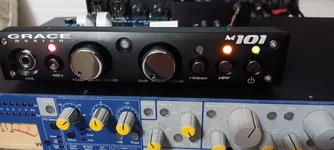
Grace M101, the black one, with internal power supply and the Ribbon button. Rev 2 and a Unbalanced and Balanced Line Out! very nice.
I suspect not much in sound difference, nothing mentioned online about rev1 and rev2 sounding different so Ill assume same CHIP type clean preamp, spec same.

$500 used, plus ship / tax. First impression was its really light to hold. Then 2nd impression, as I plugged it in, it didn't work at all. No sound!!
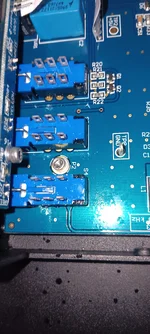
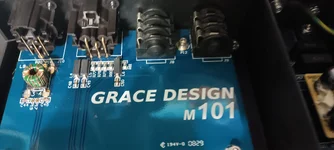
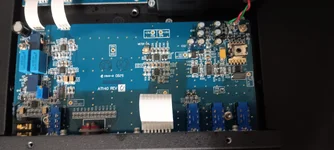
Soon that was traced to a pretty severe crackling HPF mechanical push switch. The Ribbon button too had a very loud crackling pops. So once I wiggled the buttons to get sound the volume knobs were tested and very nice feel, with a Stepped Main and a smooth Trim. I opened it up and sprayed the Detoxit and the switches were silent and problem totally eliminated. (see picture 2 )

SUBJECTIVE SOUND and CONFIDENCE:
Sound test immediately lead to compare the interface preamp.
-The Grace is built with top end stuff my interface has a tiny plastic knob.
-The Grace has solid connections Neutrik, Balanced out and Unbalanced Out, it has DI, solid unit offering confidence of top tier gear."industry standard clean preamp"
-I don't have a Ribbon mic but the Ribbon button can be used on dynamics and when pushed the impedance changes and the +48 turned off. An option I might never use.
-The Grace has 75db gain, similar the ISA One that has tons of gain too. My interface works best with hotter mics, the hsssss starts when preamp is pushed into 90-full gain.

Playback of both tracks on both m101 and Interface using the GraceDesign 902 headphone amp with Beyer 280-250ohm, and my results were "the interface preamp sounded really fine, ok, and had no negatives. I doubt anyone could tell a difference" in my HR-hobby hole recordings. Some claim in a top tier studio you can hear the Grace shine more, I don't doubt that one bit. Monitoring is key.
Still its a confident piece of gear, Clean king, ..released in 2008 black-face rev 2, so might need some detoxit on the mechanical switches.

Cheers!
 

Attachments

  • Grace M101.webp
    Grace M101.webp
    420.8 KB · Views: 78
  • Grace crackling switches.webp
    Grace crackling switches.webp
    879.5 KB · Views: 47
  • Grace design M101 internal.webp
    Grace design M101 internal.webp
    301.3 KB · Views: 43
  • Grace M101 boards.webp
    Grace M101 boards.webp
    618.1 KB · Views: 53
According to Grace it adds 10db more, so 85db... Its weird, imo.. when pressed it automatically turns off the Phantom 48v, but when deselected=OFF, if the 48v is On as before. Im not a Ribbon mic expert so this function doesn't do anything for me. I guess for a SM7 or low RE20 you get 10db more.

Main Gain is 65db and the second knob Trim can add 10db more. I had it full blast and pretty quiet.

1780084037696.webp
 
According to Grace it adds 10db more, so 85db... Its weird, imo.. when pressed it automatically turns off the Phantom 48v, but when deselected=OFF, if the 48v is On as before. Im not a Ribbon mic expert so this function doesn't do anything for me. I guess for a SM7 or low RE20 you get 10db more.
Ribbon mics aren't supposed to get 48v Phantom - so when pressed it turns it off as a safety feature - then when you turn the boost off I think it assumes you aren’t using a ribbon anymore.

Main Gain is 65db and the second knob Trim can add 10db more. I had it full blast and pretty quiet.
With which Mic? Everything except a SM7 or ribbon 75db is more than enough - my Ribbons do well at 60db.
 
I agree, the Ribbon removes the 48, led goes off. If a person accidentally pressed it ...doh!

I tossed up a SM7 and then MXL67G. briefly, 1hr or so...full gain just to see what happens with HSSS noise! lol not needing gain., I wasn't recording full blast., it was just testing the knobs etc see if it works. I was at 50% or so, no problems plenty of gain. I worded that wrong. I had it full blast just to listen for noise, "waterfall" HSSS.

The M101 has a simple Gain knob thats stepped 5db each I read, the Trim is linear for fine tuning. No transformer overdrive.
If the Ribbon button is pressed for a Dynamic there's another 10db apparently, that's cool to have and Impedance is higher.

The black-face Grace has Unbalanced Output, the original Chrome-Face didn't have that. That's a nice option with an interface that has Unbalanced Line In like the Line6UX8.
Antelope Audio Zen Go interface I have is all Balanced I/O Neutrik, when its working. I's the most buggy unit Ive ever had.

1780089705905.webp


1780089937907.webp
 
Last edited:
I agree, the Ribbon removes the 48, led goes off. If a person accidentally pressed it ...doh!

I tossed up a SM7 and then MXL67G. briefly, 1hr or so...full gain just to see what happens with HSSS noise! lol not needing gain., I wasn't recording full blast., it was just testing the knobs etc see if it works. I was at 50% or so, no problems plenty of gain. I worded that wrong. I had it full blast just to listen for noise, "waterfall" HSSS.

The M101 has a simple Gain knob thats stepped 5db each I read, the Trim is linear for fine tuning. No transformer overdrive.
If the Ribbon button is pressed for a Dynamic there's another 10db apparently, that's cool to have and Impedance is higher.

The black-face Grace has Unbalanced Output, the original Chrome-Face didn't have that. That's a nice option with an interface that has Unbalanced Line In like the Line6UX8.
Antelope Audio Zen Go interface I have is all Balanced I/O Neutrik, when its working. I's the most buggy unit Ive ever had.

View attachment 152680


View attachment 152681
What is the rolloff on the HighPass Filter? Seems pretty straight forward - don’t like the color on the LEDs - or at least in the picture they seem distracting.
 
its a nice HPF , imo, standard 75hz...most are 80 or so that I like.
some like that U87AI was horrid and started like 300hz or some say 500hz!
the AKG 414 is great hpf and has several to choose.....or leave it flat and do it in the DAW.
Grace is able to remove crap, without robbing the lower pleasent low hz.

I splurged on some cables/ neutriks and will mess some today with it.
Test Drive- 43 days left to return it..lol
its $500 for one qty., Clean preamp. used. hmm?
Day 2- Im using a UX8 2009 interface, or the "sometimes firmware -working Antelope Audio" , plan to compare the three "clean" preamps.
The UX8 interface is chip while the Antelope is discrete, but clean... the outboard Grace is simple and fast, kind of LA2A like , simple gain and a fine tune.
Not much for IO, in comparison to a ISA One, right?

Clean Mic preamps aka Chip based,
 
About a week later, replaying the Grace M101 track vs interface preamps and other outboard preamps ISA430/JoeMEekVC1Q, they all sound about the same and the Mics make more a difference. Nothing new here that hasnt been said 1000 times. I went through a pretty deep HR a few years ago on preamps and same results.

Sounds lame to say it but there's some confidence in getting a name brand, pro brand. Grace Design, there's a legacy of well made- transparent gear the name brand gives confidence in product due to professionals whose wide arrange of experience give thumbs up to.
Many remember the Great River Pre vs $29 Art comparison blindfold where Art got 41 Orange votes to the GR 14 Apple votes.
Doesn't mean anything but sound, nothing to do with build quality and longevity but $29 vs $1100? hmm? for HR , for me the name brands then become more "confidence" purchases, placebo like. Still Great River is well liked by Pro;s and Art not so much...despite the SOS blindfold also showing many chose the ART MPA?

how much of it is psychology?

the confidence is there to plug any mic into a Grace Design transparent invisible preamp and feel this is the mic sound.
the reality seems plugging into my interface pre gives the same sound?
The Mind Game is my old Line6 UX8 is $150 used and has 8 ty preamps that all sound the same as the Grace Design m101 $550 used.
so 8x $550 would be $4400. Should my Line 6 interface be selling for $5800? It has AD/DA, it has straight LINE IN, and really good Headphone amp for 300ohm designed.
Maybe my Line 6 UX* should sell for $7500??!!

I have 3qty, maybe Ill post one on Reverb for $7500....anyone want a Line 6 UX8? Ill sell it cheap to HR members for $5500....$2000 savings!

lol
 
Still Great River is well liked by Pro;s and Art not so much...despite the SOS blindfold also showing many chose the ART MPA?

What’s a ‘Pro’? And the Art is well liked - most people use them because the Great Rivers are expensive - especially after that blind test came out.
how much of it is psychology?
If you ask me most of it is Eye Candy not psychology - seeing an expensive piece of gear is 80% of liking it.

The Mind Game is my old Line6 UX8 is $150 used and has 8 ty preamps that all sound the same as the Grace Design m101 $550 used.
Preamps are over rated - what makes thing sound the way they sound are the people recording it skill set.


so 8x $550 would be $4400. Should my Line 6 interface be selling for $5800?

I have 3qty, maybe Ill post one on Reverb for $7500....anyone want a Line 6 UX8? Ill sell it cheap to HR members for $5500....$2000 savings!
Just shutup already - why do you have let the secret out?:LOL:
 
true.
80% eye-candy ... is interesting comment.

Some reason I think of RANE mic preamps as most simple plain gain, they used a chip and one knob.
Pretty sparse preamp, but Roger Nichols talked of using them on Steely Dan albums, known for hi-end sound. Chip based preamps seem the simplest cheapest approach.
My interface is 8qty, chip preamp with one knob, probably very similar to most chip preamps on interfaces.

Then this "simple" design is taken further with better specs, better knobs, fancy packaging, more I/O, led or VU meters, dressed up and marketed in a good way. Each of these things add to price, but the sound is still a chip-amp design, higher quality parts and build materials expensive...Grace Design , Martech, and probably most Chip Preamp designs on steroids but sounding similar.

off topic-
I've been waiting for months for the backordered Behringer ADA8200 $179 for 8 qty chip preamps, with 8qty analog outputs, and 8qty 1/4 line inputs x 8qty, with ADAT output.
Somehow the ADA8200 Behringer has Balanced or Unbalanced LINE OUT? one XLR?
How is this possible? the Grace M101 has Balanced or Unbalanced but two outputs, XLR or 1/4inch.

1780746292203.webp
 
Last edited:
off topic-
I've been waiting for months for the backordered Behringer ADA8200 $179 for 8 qty chip preamps, with 8qty analog outputs, and 8qty 1/4 line inputs x 8qty, with ADAT output.
There are used ones all over the place for $120.


Somehow the ADA8200 Behringer has Balanced or Unbalanced LINE OUT? one XLR?
How is this possible? the Grace M101 has Balanced or Unbalanced but two outputs, XLR or 1/4inch.
You have to make cables for Unbalanced XLR to 1/4” Jacks - it was done to save space and dollars.
 
Theyve been backordered for months. Now that I read it more its not what I want. I thought it was straight preamp/but seems it isnt.
 
Adding - This is a high tech Audio Science Review 2026 on GRACE DESIGN M101.
Very deep dive tech and claims the Grace Design has better specs than Grace claims!! ..funny.

Week 2 or 3 here? hmmm? Had some more time with the GRACE... vibe is a confidence that your mic is getting tracked 100% no "blurry" added.
I went through my small mic locker and using the GD M101 also gives confidence relying on Disney engineers choosing it and a vast amount of pro's using the Grace clean-brand and its legacy continues still, adding to integrity.

Grace business gang must run a good company and didn't get greedy in offshoring for cheaper cheaper cheaper stuff, "the race to the bottom."
Grace Design didn't go the route that clouds, can ruin, and/or confuses their brand quality.
1994--2026, still maintaining confidence in the brand of clean and transparent.

Still Used at $550 is serious cash, right? Some version 1 are $350+/-...
others? SPL Mic PreOne (odd name for a dual preamp? w/ DI- $600 used), Behringer dual 1273 add another $100, $600 used but dual.
Audeint Mico dead model but used! or keep the cash and use the Interface PreAmps that are pretty clean too...lol:drunk:

happy holiday and happy gear diving
 
Somehow the ADA8200 Behringer has Balanced or Unbalanced LINE OUT? one XLR?
If I remember right, my ADA8000s have regular XLR balanced ins on the front, and TRS balanced or unbalanced outs on the rear.
When it feeds an unbalanced input, one of the balanced signals will get connected to ground/chassis.
 
A few days ago, Jim Lill posted this on Youtube. It cause a bit of a firestorm on a certain gear forum. The funny thing reading the threads (multiple) was the number of people who dismissed everything without even watching the video, and throwing out every reason he was wrong, how he didn't look at this or didn't look at that. The vitriol was amazing! In fact, most of the complaints were the exact things Jim tried to explore.

You know the standard comments.... "you won't hear the difference until you push it into saturation", "you can't tell the difference until you stack tracks" " you can't hear it unless you have quiet tracks", "it's in the transients", "it's the compression", "it's the impedance". Some people were convinced that he wanted to show that a cheap interface was a good as an expensive one, but his original goal was to see why gear his favorite group used was supposedly better than his home gear. It turned into a "why doesn't it sound any better that my Scarlett?"

It's a bit lengthy, but I suggest you give it a full view.


A few days ago, Jim Lill posted this on Youtube. It's a bit lengthy, but I suggest you give it a full view.
This guy isn’t wrong - is Preamp Y better that Preamp X though? - IME preamps aren’t major players in the sound game - so my answer has mostly been No - however I have a Scarlett 2i2 Ver 4 and a Apogee Duet 3 - and the Duet is more solid sounding on Playback - but that’s not the preamps - that’s the convertors - and that’s something this guy didn’t address - Convertors do sound different but mostly look the same on Profiling - he was running his Neve through Apollo convertors and they sound different that Scarlett convertor - but profiles will look the same - so he’s got a pretty big gap there.
 
Can you explain what you mean by "the profiles will look the same"? Also, he could very easily use the Direct Monitor of the 2i2. That would sends the signal from the input straight to the line outputs to then feed into the Apollo line in so that both would use the same converters. That takes any converter issue out of the equation as now you are just looking at the analog preamp section. You wouldn't want to use an ADAT out to feed the Apollo as that would use different AD converters.

A converter is looking at a voltage and saying that it's a level 5 or a level 6 on the way in, saving that number and then on the way out, it looks at a pair of samples and makes an interpolation of the voltage curve between them. If sample 1 is a 2 and sample 2 is a 15, it will ramp voltage accordingly. It shouldn't magically make a note last longer, or make a bass note stronger. Whether you're using an ESS or a Cirrus Logic or AKM chip, the defining difference should lie in how accurately it sampled the voltage coming in, and how well it ramps voltage between sample values on the way out (no stair steps, remember?). It knows nothing about what's coming up a hundred samples from now, or if its reproducing a 20 cycle tone or a 2000 cycle tone. I'm confused as to how that would make something more solid, or boost the bottom, or smooth the midrange, unless it's been affected by some type of filtering (aka EQ) either in the analog domain or digitally. My Tascam has DSP EQ and compression built in but that's separate from the actual AD-DA process.

I think the key thing in Jim's video is that he assumed that he would hear the "magic" if he used the same equipment as was used in Ocean Way's console instead of his 2i2 that he used at home, and in the end, he didn't hear the "magic". He seems to be a curious fellow, so he asked the perfect question... WHY? Try as he might, he never found the pixie dust in that high dollar preamp.

I'm sure there are some people (probably very few) who might be able to reliably hear the differences. It's like a race car driver who can tell a quarter degree difference in wing angle at 200+MPH. On the other hand, as I heard one engineer say "If you're down 50 HP, you can trim out the wings completely flat and you'll still get passed on the straights". Tiny things only make a difference if the big stuff is fixed first.

BTW, my old debate teacher would have flunked about 90% of the people who replied in those threads. Very few people actually addressed any of the points of the video, instead attacking the person, the music choice, making assumptions about his background (he's actually got a degree in audio engineering), even complaining about the lyrics of his song. Personal attacks are the very WORST things you can do in a debate (unless you're a politician). Or they repeatedly said "he didn't consider X" (yeah, he did... go to Y minutes into the video). But what does he know... he's only a guitar player!

It got comical in spots, tiresome after a while.
 
Last edited:
Can you explain what you mean by "the profiles will look the same"? Also, he could very easily use the Direct Monitor of the 2i2. That would sends the signal from the input straight to the line outputs to then feed into the Apollo line in so that both would use the same converters. That takes any converter issue out of the equation as now you are just looking at the analog preamp section. You wouldn't want to use an ADAT out to feed the Apollo as that would use different AD converters.
If you used the direct monitor of the 2i2 why would you have the 2i2 in the chain? Anyways - at the outputs of the 2i2 and Apollo one measures the signal to see if there is a difference - and what I’m saying is the frequency measurement will most likely look the same - but you would still hear a difference - and that’s the convertors working - why we can hear it but not see it is beyond my knowledge - but I’ve measured my 2i2 and Duet and the frequencies are nearly matched - but there is a audible difference in the sound - maybe it’s the micro difference that creates the impression - maybe I have Bat ears and am the King of Prussia too.


A converter is looking at a voltage and saying that it's a level 5 or a level 6 on the way in, saving that number and then on the way out, it looks at a pair of samples and makes an interpolation of the voltage curve between them. If sample 1 is a 2 and sample 2 is a 15, it will ramp voltage accordingly. It shouldn't magically make a note last longer, or make a bass note stronger. Whether you're using an ESS or a Cirrus Logic or AKM chip, the defining difference should lie in how accurately it sampled the voltage coming in, and how well it ramps voltage between sample values on the way out (no stair steps, remember?). It knows nothing about what's coming up a hundred samples from now, or if its reproducing a 20 cycle tone or a 2000 cycle tone. I'm confused as to how that would make something more solid, or boost the bottom, or smooth the midrange, unless it's been affected by some type of filtering (aka EQ) either in the analog domain or digitally. My Tascam has DSP EQ and compression built in but that's separate from the actual AD-DA process.
AFAIK the 2i2 and Duet do not filter the outputs - but maybe my information is wrong and they do - everything I’ve read says they don’t.


I think the key thing in Jim's video is that he assumed that he would hear the "magic" if he used the same equipment as was used in Ocean Way's console instead of his 2i2 that he used at home, and in the end, he didn't hear the "magic". He seems to be a curious fellow, so he asked the perfect question... WHY? Try as he might, he never found the pixie dust in that high dollar preamp.
I think he doesn’t hear the magic because the magic is in the performance and not the preamps - so a given tech gets the Neve based on suggestions that is fantastic - and at the same time gets a fantastic performance - so what is he actually hearing? - I think it’s the performance that makes anything sound good not the preamp - now changing mics does affect the sound - sometimes greatly - like when using a Ribbon mic versus a Dynamic mic - but once again it’s the performance that people are hearing - and in that case they can make a value judgement - they think the Ribbon sounds better than the Dynamic on that particular voice and that particular take - but in this case it doesn’t mean one mic is better than the other - only that one of mics is better suited to the singer.


I'm sure there are some people (probably very few) who might be able to reliably hear the differences. It's like a race car driver who can tell a quarter degree difference in wing angle at 200+MPH. On the other hand, as I heard one engineer say "If you're down 50 HP, you can trim out the wings completely flat and you'll still get passed on the straights". Tiny things only make a difference if the big stuff is fixed first.
Most of that higher end tech is only noticeable to complete professionals - I doubt I could tell even I somehow reached 200 mph - so as far as preamps are concerned I am a professional - and what guy said didn’t surprise me at all - I’ve known that for years - for the most part I’ve always been happy with what ever preamps I used - not things that do make a difference - A Fairchild 660 for one - when I had a working one that was up to spec there was nothing that could touch it - but this might be controversial but I’ve found plugins that react the same way - and without the digression over time.


BTW, my old debate teacher would have flunked about 90% of the people who replied in those threads. Very few people actually addressed any of the points of the video, instead attacking the person, the music choice, making assumptions about his background (he's actually got a degree in audio engineering), even complaining about the lyrics of his song. Personal attacks are the very WORST things you can do in a debate (unless you're a politician). Or they repeatedly said "he didn't consider X" (yeah, he did... go to Y minutes into the video). But what does he know... he's only a guitar player!

It got comical in spots, tiresome after a while.
The guy posted a controversial subject - people get ugly because they either have to question their gear or question the guy -and questioning the guy saves the milliion dolllar studio owners butt.
 
Last edited:
If you used the direct monitor of the 2i2 why would you have the 2i2 in the chain? Anyways - at the outputs of the 2i2 and Apollo one measures the signal to see if there is a difference - and what I’m saying is the frequency measurement will most likely look the same - but you would still hear a difference - and that’s the convertors working - why we can hear it but not see it is beyond my knowledge - but I’ve measured my 2i2 and Duet and the frequencies are nearly matched - but there is a audible difference in the sound - maybe it’s the micro difference that creates the impression - maybe I have Bat ears and am the King of Prussia too.
Using the direct monitor only engages the preamp section, not the DAC. If you're comparing the preamps, that would be the logical starting point. Or he could just compare the 2i2 to the Neve/Apollo combo. If that sounds essentially the same, then you've got a couple hundred bucks vs close to $8-10K which is even more radical of an idea!

I think he doesn’t hear the magic because the magic is in the performance and not the preamps - so a given tech gets the Neve based on suggestions that is fantastic - and at the same time gets a fantastic performance - so what is he actually hearing? - I think it’s the performance that makes anything sound good not the preamp - now changing mics does affect the sound - sometimes greatly - like when using a Ribbon mic versus a Dynamic mic - but once again it’s the performance that people are hearing - and in that case they can make a value judgement - they think the Ribbon sounds better than the Dynamic on that particular voice and that particular take - but in this case it doesn’t mean one mic is better than the other - only that one of mics is better suited to the singer.
That was his main conclusion. That's the big parts. The musicians, instruments, song, mics and room have the biggest role in creating the sound.
Most of that higher end tech is only noticeable to complete professionals - I doubt I could tell even I somehow reached 200 mph - so as far as preamps are concerned I am a professional - and what guy said didn’t surprise me at all - I’ve known that for years - for the most part I’ve always been happy with what ever preamps I used - not things that do make a difference - A Fairchild 660 for one - when I had a working one that was up to spec there was nothing that could touch it - but this might be controversial but I’ve found plugins that react the same way - and without the digression over time.
He found the same. The EQ section was a great example. The way the ProTools EQ worked was totally different from how the Neve worked. But you could buy the Waves, UA, or IK plugins and get essentially the same responses.
The guy posted a controversial subject - people get ugly because they either have to question their gear or question the guy -and questioning the guy saves the milliion dolllar studio owners butt.
Yeah, you don't want to attack someone's sacred cow!
 
Back
Top