Clipping wireless.

  • Thread starter Thread starter FrankD77
  • Start date Start date
You mention Legato/Joyo not publishing their voltage limitation. That's only 1/2 of the problem. The other side of the problem is that pickup makers almost never publish output voltage specs. Everyone publishes how many ohms the coils have, but talking to a fellow last week who designs pickups for a living, one of his first comments was that resistance is meaningless by itself.

It would help a lot if there was a standard for measuring the output, much like is used for a microphone. mV output for 1Pa (94dB) is the reference more often quoted for a mic, and people then use that info to know if their preamps have sufficient gain.

Pickups have the opposite problem. Nobody knows what their guitar's output is, they just plug into the input and turn up the knobs and if it distorts, that's good. If not, they stick a booster pedal in there to drive it into distortion. How hard you strum, how close are the pickups, even the type of strings will change the level. We need a standard test rig with a automatic strummer or some other way to excite the coil, set the pickup height, hook up to a proper meter or scope, and measure the dang things!

Then we won't be trying to put 2 gallons in a 1 gallon bucket!
 
Or just variable input. Problem solved

Pickups you also have age, height, string gauge, how hard the player digs in.

;)
We are a bunch of variables.
 
Cannot ever see a way to "calibrate" pups? You could drop a known mass on a string from a known height but which string? BUT! It ain't rocket science to get a few pickups of various types and bolt them to cheap Tele copies to get some idea of the voltages involved. (something Frite obviously didn't do early on!)
An FCS! The Triode valve has been around for 100 years! The bias voltage and distortion characteristics are on record every fekking where. There is NO excuse NOT to know that more than 2-3V pk-pk will cause cut off and grid current so you just apply that knowledge to any other devices that will be used with geetars!

Dave/


@
 
Cannot ever see a way to "calibrate" pups? You could drop a known mass on a string from a known height but which string? BUT! It ain't rocket science to get a few pickups of various types and bolt them to cheap Tele copies to get some idea of the voltages involved. (something Frite obviously didn't do early on!)
An FCS! The Triode valve has been around for 100 years! The bias voltage and distortion characteristics are on record every fekking where. There is NO excuse NOT to know that more than 2-3V pk-pk will cause cut off and grid current so you just apply that knowledge to any other devices that will be used with geetars!

Dave/


@
Or order the hottest one and test that one, add some headroom and done.

I'm now left with a unit i dont use anymore and absolutely no response from lekato.
 
Looking further, I see some unit that say Passive and Active modes, like the Xvive AC58 or Fender Telepath. I'm guessing these change the sensitivity, but I'm sure that the additional circuitry contributes to some of the additional cost. Kicking up the available headroom on the transmitter side might not affect the battery life, but kicking the output of the receiver from ~1.5 to something like 5 or 6 volts would probably cut battery life. I wonder if the issue is the receiver or the transmitter.

Of course, turning down the volume on the guitar will lower the voltage. But you might not be getting the same output from the receiver that you get from a cable.

So far, NONE of the systems have quoted applicable input/output voltage levels. I guess it would be simple enough inject a sign wave and increase the voltage on the input, then read the output signal on the other end. You don't need a guitar pickup to do that.
 
For me the problem was showing up very noticable on my 7 string with invaders.
It was impossible to get a clean tone and the bass strings sounded terrible.

After this I started to hear it also on the jems and even on a strat.
 
WRT the "passive and active" point? The extra cost is minimal. a wee slide switch and two SMT resistors at the input. The circuit will not impact the noise performance because that should be determined by the quality (or not!) of the active circuitry...again, we have had " hi, lo. jacks on amps FOREVER!. Neither will it compromise "da tone" because again, the active circuit is a buffer. I still say however that backing off a passive guitar's VC causes more tonal change in the gitist's head than in fact.

Dave.
 
WRT the "passive and active" point? The extra cost is minimal. a wee slide switch and two SMT resistors at the input. The circuit will not impact the noise performance because that should be determined by the quality (or not!) of the active circuitry...again, we have had " hi, lo. jacks on amps FOREVER!. Neither will it compromise "da tone" because again, the active circuit is a buffer. I still say however that backing off a passive guitar's VC causes more tonal change in the gitist's head than in fact.

Dave.
Depends on the design of the electronics
On most i clearly hear a difference in the treble .
Plus you have to change settings on the amp and keep in mind to not pass the barrier.

I just want to play ;)
 
Depends on the design of the electronics
On most i clearly hear a difference in the treble .
Plus you have to change settings on the amp and keep in mind to not pass the barrier.

I just want to play ;)
The "electronics" in the guitar is just your bog standard potentiometer. Yes, backing that off with a long cable to an amp can cause HF loss but the cable to a wireless device can and should be very short, <1m and have no effect on the tone. "Setting on the amp"? You have to make up the gain somewhere. This is gain staging 101.

Er? Barrier? Sound? Blood-brain?

Dave.
 
On an audio group on FB a Chinese wireless mic manufacturer popped up with details of their new system asking if it did what we wanted. I asked about input pads to avoid distortion. He explained it had receiver adjustment. I told him about the lack of pads on many Chinese systems, and a new fella popped up. An engineer. He asked me to explain why this was important? I said well, maybe the mic will be two feet from a quietly speaking person at a funeral, or maybe it is on the lips of a thrash metal lead singer, screaming into it. The ultra wide dynamic range of their digital systems they had assumed were enough to make input manual adjustment unnecessary. The real range, he had vastly underestimated. He didn’t have an answer, but did suddenly appreciate the problem. Guitar wireless wise, the the Line 6 I have does a really good job on my basses, but it was unreliable because the battery cover constantly broke. After a few replacements, I gave up.
 
Some numbers? A mtr of Klotz AC10* which has a middle range capacitance of 70pf/m gives a 3dB loss at just over 9kHz when the guitar's VC is set at the worst case -6dB and is a 500k pot, will be better for a 250k control.
9kHz is beyond the range of most guitar speakers, it is really unwanted "fizz" territory, but is in any case easily restored if wanted by the merest tweak of the amp's treble control.

*There are lower cap' cables and MUCH worse! Belden 8412 e.g. is 190pf/m.

Dave.
 
Hi Rob. An input pad for a balanced mic input is of course a bit more complex than unbalanced. They have to employ THREE tiny resistors (actually better four). Oh! The additional expense!
Dave.
 
I get your story

But 1: i don't want to think about where to put the volume pot. I'm moving it all the time.

But 2: even with the wireless i hear a drop in treble on most guitars. Maybe your setup uses a treble bleed circuit. I'm mostly playing old guitars which didn't have this.

But 3: they should just get it right. Or at least put a warning on their gear.
;)
 
I get your story

But 1: i don't want to think about where to put the volume pot. I'm moving it all the time.

But 2: even with the wireless i hear a drop in treble on most guitars. Maybe your setup uses a treble bleed circuit. I'm mostly playing old guitars which didn't have this.

But 3: they should just get it right. Or at least put a warning on their gear.
;)
I agree! They SHOULD get it right but you have what you have so, adapt and overcome or upgrade!

A buffer between guitar and device would keep the pot from sucking tone. Then the cable could be as long as you like. Maybe even incorporate a slight pre-emphasis a la Mr May? (AKA treble boost)

I no longer play guitar just a tekky old fekker. Bit o bass now and then...can still hear that!

Dave.
 
Treble boost is something else ;)
Treble bleed is inside the guitar, treble booster is a pedal or circuit near the amp to make dark amps a lot more overdriven.

I did upgrade...
Back to the cable.
Im now only using the wireless with my travel guitar in the garden ;)
 
Treble boost is something else ;)
Treble bleed is inside the guitar, treble booster is a pedal or circuit near the amp to make dark amps a lot more overdriven.

I did upgrade...
Back to the cable.
Im now only using the wireless with my travel guitar in the garden ;)
Still just caps and Rs however you do it. A bleed cap compensates to some extent for the treble loss from a cable on a passive guitar. You find the very same circuit inside amps when it is known as "treble boost"!

There is nothing mysterious, magical or electronically complex about all this but then the electric guitar world has always been soaked in snake oil!

Dave.
 
With longer cables absolutely. However they claim it's the replacement of a cable with no loss. Customer shouldn't solve it or take into account.

Treble loss is less with wireless with long runs that's a known fact.

But I still hear it using a 3 MTR cable and studio setup. So i asked google ;)

Even though the wireless system stops cable loss, you might still experience a loss of high frequencies when rolling down the volume knob because:
  • Internal Guitar Capacitance: Your guitar still has internal wiring, a tone capacitor, and inherent pickup resistance. Turning down the volume knob alters the internal electrical balance, which can still dull the high-end slightly.
Slightly is also what i hear. It's not a lot.

I did want to add the difference between treble bleed and treble booster.

A treble bleed is a passive mod inside your guitar that preserves high frequencies when you turn down your volume knob, whereas a treble booster is an active electronic effect pedal that cuts bass and drives the upper-midrange and high frequencies of an overdriven amplifier. I have one in the vox mv50 when engaged it's a huge difference. Almost like an overdrive and it cuts the bass a pretty amount.

They are very different tools serving entirely distinct purposes in a guitar signal chain.

In the end it's all parts and electronics of course. Like we are all just water holders ;)
 
With longer cables absolutely. However they claim it's the replacement of a cable with no loss. Customer shouldn't solve it or take into account.

Treble loss is less with wireless with long runs that's a known fact.

But I still hear it using a 3 MTR cable and studio setup. So i asked google ;)

Even though the wireless system stops cable loss, you might still experience a loss of high frequencies when rolling down the volume knob because:
  • Internal Guitar Capacitance: Your guitar still has internal wiring, a tone capacitor, and inherent pickup resistance. Turning down the volume knob alters the internal electrical balance, which can still dull the high-end slightly.
Slightly is also what i hear. It's not a lot.

I did want to add the difference between treble bleed and treble booster.

A treble bleed is a passive mod inside your guitar that preserves high frequencies when you turn down your volume knob, whereas a treble booster is an active electronic effect pedal that cuts bass and drives the upper-midrange and high frequencies of an overdriven amplifier. I have one in the vox mv50 when engaged it's a huge difference. Almost like an overdrive and it cuts the bass a pretty amount.

They are very different tools serving entirely distinct purposes in a guitar signal chain.

In the end it's all parts and electronics of course. Like we are all just water holders ;)
The bleed cap can only compensate precisely for one value of cable capacitance which is by far the greatest capacitance in question. "Internal wiring capacitance"? Naff all and the tone cap only has an effect if you turn it on. Bit daft to compensate for something that is doing what you want to do? Chop top!

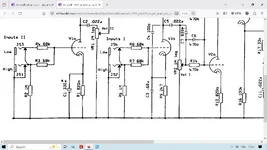
Attached is a section of a Marshall guitar amp and shows EXACTLY the same circuit topology* as you find in guitars N.B. it is NOT compensating for the input capacitance of the following Triode. That is a cathode follower so C in is buggerall. (their might of course be a section of 'cappy' screened cable twixt pot and valve grid but it would have to be pretty long!)

These are not "very different things serving different purposes" they are the same caps and pots producing the same effect...boosting treble according to the setting of a potentiometer.

I have been there when these component values are worked up. The process consists of a lot of soldering, a lot of bad words, a lot of guitar thrashing. Lots of tea and a few fags in the yard. As I said, rocket science none of it is.

Dave.
 

Attachments

  • treble boost.webp
    treble boost.webp
    77.4 KB · Views: 28
Great info and interesting.
There are indeed a load of mods. Love experimenting. Though can't do them myself except changing and biasing tubes.

fact stays that some wireless systems are not having enough headroom making them almost unusable.
 
Last edited:
Back
Top