Narrowed down to three! (For acoustic guitar)

  • Thread starter Thread starter quietude
  • Start date Start date

Which of these mics will be best for recording my acoustic?

  • Shure SM81

    Votes: 8 44.4%
  • Shure KSM137

    Votes: 0 0.0%
  • AKG C 451 B

    Votes: 10 55.6%

  • Total voters
    18
not sure that proximity effect is in fact the up front in your face sound you are talking about.(maybe, maybe not) If you could post a small sample of your recording and give a specific example of a recording you want to sound more like it might help out a bit more.
I only say this because I have made AC recordings that sound like the recordings I like without using any proximity effect, but proximity effect is desirable if that is indeed what you are after.
 
Last edited:
In my experience, proximity effect increases the bass-iness of the signal when the sound source up real close to the microphone (like a few inches) - yes the SM57 does it. You might want it if you have an instrument or voice that sounds bad because it doesn't have enough bass (note that it can sound good without added bass and can sound bad for reasons other than not enough bass, and in neither case would you want proximity effect).

On the other hand, sounds reverberating in the room can make for a nice reverb sound or (more likely) can screw up certain frequencies in the desired sound by accentuating them too much or by canceling them out. The "comb filter" effect, when reflected sound cancels (and silences) a bunch of narrow bands of a sound's frequency spectrum (resembling a comb when seen visually) can make a sound crappy and thin (sort of like a flanger stuck in one position), and when combined with the other undesirable effects of reflection, can result in an all around bad sound that no microphone (with or without proximity effect in effect) can fix.

To be sure, getting close enough to the microphone to create proximity effect will also bring the desired soundwaves into more prominence than the undesired reflections, lessening their yucky effects, but it's not really a fix for the problem, and the proximity effect bass-add really has nothing to do with any improvement in this regard.
 
I don't mean to hijack the thread, but I would like to make clear what I'm getting at here.

I'm not talking about just the "undesired reflections" as antichef called them.

I'm talking about the physical interaction of the guitar and the room.

In my own case, the most obvious interaction is occurring between the guitar and the parallel ceiling and floor, but the same phenomenon must also be occurring between the guitar and the parallel pairs of walls. It is possible to move the playing position around some looking for a sweeter spot vis à vis the walls, but my point still holds, and you're stuffed anyway with the ceiling if it's low.

And yeah, maybe I've got this all wrong! But I don't think so. If your guitar is good and responsive, then it's going to start resonating unfortunately when it finds itself vibrating at certain frequencies, depending on where it is in relation to the walls, ceiling, and floor. And when the guitar does that, it just sounds poor to me. I think of it as "choking" the sound, which of course means less than nothing to anybody else I guess.

This has nothing to do with reverberation, and everything to do with the physics of the interplay of an acoustic guitar and a small acoustic space.
 
I think I'll go manufacture myself a homemade gobo and see where that gets me, I've been thinking of doing something like that for a while.

I still want a new microphone though, especially after learning of this "proximity effect." Which cheapish microhpones are effected by proximity? Would a SM57 be?

I still haven't completely ruled out a Beyer MC930 (would that provide the proximity effect?), but after reading what maccool had to say, I'd be worried that I'd just be picking up even more of the room, since it's an expensive, sensitive mic. Or would a gobo eliminate that issue?

Am I becoming rapidly obsessed with the "proximity effect" when I shouldn't be? :p
exspensive mic's are sensitive too..my se can pick up dogs barking 2 blocks down the road!!

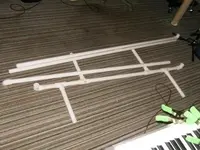
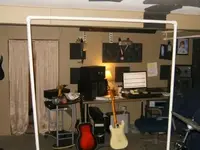
Here are a few pic's of the one I made
. It's pretty big so it is hard to get the whole thing in one shot.
Takes about one minute to put up!!
 

Attachments

  • 000.webp
    000.webp
    22.5 KB · Views: 184
  • gobo 001.webp
    gobo 001.webp
    14.2 KB · Views: 187
  • gobo 003.webp
    gobo 003.webp
    13.1 KB · Views: 184
No ones mentioned it so I will.............. An SDC mic will eliminate a lot of the rooms' troubles as the pattern is so small and well defined. I clarify this by saying the mics mentioned all have this trait.....there are those out there that dont. This will get you closer to that 'immediate' upfront sound though by no means will it solve an untreated room. An SDC mic will also allow you to find the sweet spot on your guitar and take advantage of it.

As for a 'bright' mic vs. a 'not bright' mic, I think you need to seriously listen closely to your guitars performance from the front. This means someone else playing it in a style similar to yours. What we hear above the bout of the guitar and tucked in under the arm isnt necessarily what the mic will hear. A few moments spent in hearing from this position will give a much better idea what mic you need to select in order to accomplish what you want.

You might actually NEED a bright mic to get that forward sound............
 
There is so much bad information on this thread that your penance is to read Harvey's big thread until you realize this too.
 
There is so much bad information on this thread that your penance is to read Harvey's big thread until you realize this too.
Sigh, it's true. But think of it as your salvation (from eyepatch wearing cats - not generally considered a good source of advice on many topics) instead of your penance -- it's a sticky at the top of the mic forum.
 
Last edited:
I think I've found a matched pair on thomann. I'm unsure of the model number though. OKTAVA MK 012-01 MSP2. Anyone got any idea what the 01 MSP2 signifies? I can't post a link as I haven't posted enough times to have that luxury..

The -01 means single capsule version (cardioid). I don't know that many people who have ever used the three-capsule version because they're a lot more expensive, but if you have the dough for it, that would obviously give you some other interesting options.

I think the MSP means matched stereo pair. No idea what the 2 means. :)
 
There is so much bad information on this thread that your penance is to read Harvey's big thread until you realize this too.

Yup.


My recordings all have no hiss on them (which troubles me, because all my favourite records seem to be riddled with it)

That's because mic amplifier circuit design has improved markedly over the past few decades and most of your favorite recordings probably date back more than a few years. :)


which I suppose is good, but the guitar just sounds so distant. It doesn't sound instant and in your face at all. Would that be due to the mic "capturing all the room?"

Maybe. If the "distant" sound sounds kind of phasey like when you stand right in front of a wall and talk towards it (or talking through a tin can telephone), then the effect is probably caused by early reflections off of nearby hard surfaces. You can reduce this by recording in a bigger room, covering hard surfaces (walls, ceiling, etc.) with something that absorbs high frequencies, moving the mic closer to the instrument, using a piezo pickup (with a lot of EQ), sitting with your back to the wall facing down the longest axis of the room, or some combination of the above. If it doesn't sound like that, though, it is probably not the room causing your problems.

My guess? The "distant" sound is probably not caused by the room. That said, improvements to the room are probably going to be useful, particularly when it comes to eliminating room modes (the effect that maccool mentioned where certain frequencies are massively emphasized and others are massively nulled out). For a small room, this effect can be very obvious. An eight foot room length resonates (major boost) at the C# below middle C (and, to some degree, every harmonic thereof), for example, and basically cancels out the C# an octave below that, give or take. A six foot room length resonates at the F# below middle C. In Google, "speed of sound / 6 feet" (or whatever length/width/height your room is) gives you a frequency in Hz, then look that frequency up here.

The "distant" sound, however, is probably caused by the lack of bass response in that mic. Bass dissipates more quickly than higher frequencies as distance increases. Thus, people often perceive a lack of bass frequencies as being indicative of distance. (For more fun, read about psychoacoustics.) The AT2020 has a lot of bass roll-off, so if you're used to a boomy sounding guitar, you may very well perceive the lack of bass as being "distant". Using a mic with a flatter response curve (the MK-012, for example) will solve this problem quite nicely.

That said, whether you do this or not depends largely on what your goal is for the track. If it's a solo track, you clearly don't want it to sound like that. However, if it is part of a dense mix, once you slap a bass track down on there, you'll probably find that the guitar sits better in the mix without a lot of that low end. It just depends on the situation.


The AT2020 has no proximity effect, so you won't get that really close up sound that you want.

Pedantically speaking, it's a cardioid mic, so by definition, it exhibits proximity effect.... It is diminished substantially by the bass roll-off, but it is still there.

 
If someone already mentioned this, sorry for the redundance.

Anyway, I have noticed that even small movements in mic position make radical changes in the overall tone balance. I have gone to the trouble of "stringing" my mic distance since I'm up and down a lot, that way I can concentrate on where the mic is pointed, or if it sounds best slightly off axis or whatever rather than screwing up the distance to the mic.

I have used isolation phones to listen to the sound as I position the mic. That seems to work for me.

While I'm sure there are huge differences between mics the position may play an equal role in getting the sound you are after.

ac
 
Anyway, I have noticed that even small movements in mic position make radical changes in the overall tone balance. I have gone to the trouble of "stringing" my mic distance since I'm up and down a lot, that way I can concentrate on where the mic is pointed, or if it sounds best slightly off axis or whatever rather than screwing up the distance to the mic.

True. How much that matters also depends in part on how tight the polar pattern is. Tight hypercardioid patterns tend to be affected more by being slightly off axis than less directional patterns. That's one other advantage of the MK-012. IIRC, it tends to be less directional (or at least less sudden about it) than most cardioid mics, though still cardioid in nature.

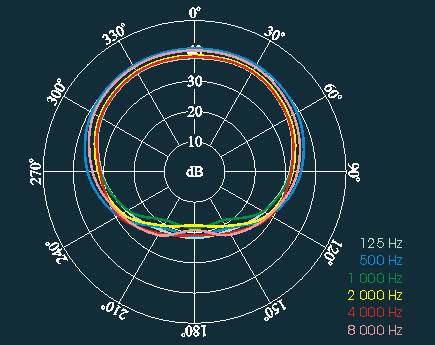
Compare MK-012 polar pattern:

mk012card_krug.gif


SM57 polar pattern:
shure3.jpg
 
Which mic to use depends on many things like room acoustics , the instrument , the arrangement , the production , etc. However I would try them in the following order:

1-Shure KSM137
2-AKG C 451 B
3-Shure SM81
 
I'm going to try and do a lot of the things mentioned in this thread, such as engineering myself a ghetto acoustic gobo.

However, I was just listening to a few samples of some of the mics recommended in this thread, including a Beyer MC930 on http://www.studioauditions.com/jamroomsessions_home.php. They seem to lack any sort of substance and sound so thin and empty.

When compared to this (scroll to the bottom where it says "Save file to your PC: click here") they sound terrible to me.

Basically that mp3 clip is where I'm trying to get. Why does the guitar in that clip I've posted sound so powerful and in your face?

Thanks again for the advice you've given hitherto.
 
However, I was just listening to a few samples of some of the mics recommended in this thread, including a Beyer MC930 on http://www.studioauditions.com/jamroomsessions_home.php. They seem to lack any sort of substance and sound so thin and empty.

If an MK-012 sounds in any way thin and empty, that's a pretty sure sign that either the engineer EQed it intentionally to get that sound or the guitar itself sounds thin and empty. It is remarkably true to the sound of the instrument, albeit sounding a hair darker than the actual instrument (the exact opposite of thin).

That said, if you still aren't fat enough with an MK-012, boost it somewhere in the mids, probably with a pretty wide Q settings---probably the lower mids, but I guess it really depends on what frequencies are weak that are causing it to sound thin; experiment.

P.S. You should set your location in the User CP area. That way, if any folks in your area happen to have some of these mics, they can offer to let you try some mics on your guitar so you'll know exactly what they will sound like. :)
 
If an MK-012 sounds in any way thin and empty, that's a pretty sure sign that either the engineer EQed it intentionally to get that sound or the guitar itself sounds thin and empty. It is remarkably true to the sound of the instrument, albeit sounding a hair darker than the actual instrument (the exact opposite of thin).

That said, if you still aren't fat enough with an MK-012, boost it somewhere in the mids, probably with a pretty wide Q settings---probably the lower mids, but I guess it really depends on what frequencies are weak that are causing it to sound thin; experiment.

P.S. You should set your location in the User CP area. That way, if any folks in your area happen to have some of these mics, they can offer to let you try some mics on your guitar so you'll know exactly what they will sound like. :)

If you listen to the sample of the MK-012 on the website I mentioned above though, doesn't it sound lifeless to you? It's near to what I've been describing as distant. Can anybody tell me why that is? Or why it's not even close to the mp3 clip I posted.

And I'll be adding my location shortly!
 
If you listen to the sample of the MK-012 on the website I mentioned above though, doesn't it sound lifeless to you? It's near to what I've been describing as distant. Can anybody tell me why that is? Or why it's not even close to the mp3 clip I posted.

And I'll be adding my location shortly!

Doesn't sound lifeless, no. Sounds a hair on the dull side like it needs a little boost somewhere up near the top to give it a little more "air".

The big thing I notice about the other clip is that it sounds like it has some reverb added. There's definitely a sense of stereo separation, etc. It may also have been recorded with two mics at different places on the guitar (with each one panned a bit off center in opposite directions), whereas the Oktava clip was probably recorded with just one mic.
 
If you listen to the sample of the MK-012 on the website I mentioned above though, doesn't it sound lifeless to you? It's near to what I've been describing as distant. Can anybody tell me why that is? Or why it's not even close to the mp3 clip I posted.
The clip you posted earlier sounds boomy on my setup, but it could be me. I'm not in love with the sample you just mentioned either -- that's not my favorite Martin guitar, but I don't know if that has anything to do with it.

Here's a clip I made recently (I've posted it in other threads) using a MC-012 (basically the same as the MK-012) on an old D-28 (it's actually a rhythm track and a lead track, mixed dry):

(edit: this has been working fine, but I'm having trouble just now - hopefully only on my end)

Oh, and since I made my hasty comment about eyepatch wearing cats earlier, I have have perused the forum and discovered that there are indeed eyepatch wearing cats worth taking advice from -- you just need to watch out for impostors :D
 
Last edited:
The "distant" sound, however, is probably caused by the lack of bass response in that mic. Bass dissipates more quickly than higher frequencies as distance increases. Thus, people often perceive a lack of bass frequencies as being indicative of distance.

I believe you have this backwards. There is high frequency loss in air over long distances relative to lower frequencies, meaning that if you're on the far end of the cathedral, the highest pitched ranks of the organ will be muted relative to the bass pedals and the bulk of the tone in the midrange just by the long travel distance through air. Also, bass tends to transmit more readily through materials than treble.

OTOH, apparent lack of bass can be produced by using a directional mike with proximity effect in the far field, since it will tend to have reduced low end response compared to, say, a true omni capsule which can be flat in the far field on the low end just about down to DC (i.e. you can measure air pressure with it!).

Cheers,

Otto
 
I believe you have this backwards. There is high frequency loss in air over long distances relative to lower frequencies, meaning that if you're on the far end of the cathedral, the highest pitched ranks of the organ will be muted relative to the bass pedals and the bulk of the tone in the midrange just by the long travel distance through air. Also, bass tends to transmit more readily through materials than treble.

That's more an issue of how reflections and absorption affect the sound. In an cathedral, you're going to get a lot of HF damping from soft surfaces like pew coverings, people, etc. You're also going to get a lot more interference due to reflections in the highs because the wavelength is shorter and thus more likely to interact with distances between hard surfaces.

Actually, on further reading, we're both wrong. :D In an anechoic environment (e.g. outside), everything falls off equally at 6 dB each time the distance doubles. The problem is that the ear pays less attention to highs and lows at lower volume. Thus, you'll perceive a quiet sound as having no highs and no lows. Basically distant sounds are perceived by the ear much like AM radio. This is by design---to maximize the ability of the ear to pick up critical voice frequencies at a distance. That said, you're far more likely to notice a lack of bass response than a lack of treble response---we've been conditioned to expect the latter to a degree, and many people can't hear the high frequency content in the first place. Everybody will notice a lack of bass response. It's immediately obvious.

For a great example of this effect, take that pair of headphones and pull them away from your ears. :)
 
That's more an issue of how reflections and absorption affect the sound. In an cathedral, you're going to get a lot of HF damping from soft surfaces like pew coverings, people, etc. You're also going to get a lot more interference due to reflections in the highs because the wavelength is shorter and thus more likely to interact with distances between hard surfaces.

Actually, on further reading, we're both wrong. :D In an anechoic environment (e.g. outside), everything falls off equally at 6 dB each time the distance doubles. The problem is that the ear pays less attention to highs and lows at lower volume. Thus, you'll perceive a quiet sound as having no highs and no lows. Basically distant sounds are perceived by the ear much like AM radio. This is by design---to maximize the ability of the ear to pick up critical voice frequencies at a distance. That said, you're far more likely to notice a lack of bass response than a lack of treble response---we've been conditioned to expect the latter to a degree, and many people can't hear the high frequency content in the first place. Everybody will notice a lack of bass response. It's immediately obvious.

For a great example of this effect, take that pair of headphones and pull them away from your ears. :)

Sorry, but you are incorrect. The attenuation of high frequencies in air is known and quantified. Consult a standard reference on acoustics, or read the text below, which I quote from The Master Handbook of Acoustics, Third Edition, by F. Alton Everest (see page 170):

"Absorption of sound in air
For frequencies 1 KHz and above and for very large auditoriums, the absorption of sound by the air in the space becomes important. For example, a church seating 2,000 has volume of about 500,000 cubic feet.

Frequency ................. Absorption
..... (Hz) ............ (sabins per 1,000 cu ft)
... 1,000 .......................... 0.9
... 2,000 .......................... 2.3
... 4,000 .......................... 7.2

Notice that for 50 percent relative humidity the absorption is 7.2 sabins per 1.000 cubic feet or a total of (500)(7.2) = 3,600 sabins at 4 kHz. This is equivalent to 3,600 square feet of perfect absorber.

This could be 20 percent to 25 percent of the total absorption in the space, and there is nothing that can be done about it other than to take it into consideration and taking consolation in at least knowing why the treble reverberation time falls off so much!"

Cheers,

Otto
 
Last edited:
Back
Top